

For about a year I did everything I thought I was supposed to do. Oatmeal for breakfast. Salad at lunch. A sensible dinner, smaller than what I used to eat. And the scale in the hallway did not move. Not up, not down, just the same number every Sunday, which is somehow worse than gaining. When I finally started weighing my food instead of eyeballing it, I found the problem in about four minutes on a Tuesday morning.
My idea of a cup of cereal was closer to a cup and a half. My idea of a tablespoon of peanut butter was closer to three. The dressing on my salad was probably two servings, not one. None of it was dramatic. None of it was a binge. It was just enough extra, every single day, to quietly cancel out everything I was doing right. The fix was not willpower. It was a small digital kitchen scale, an Etekcity, that now lives on my counter more often than any pan I own.
Here is how I actually use it, in the order I would explain it to a friend sitting at my kitchen table. Including the parts that took me an embarrassing amount of time to figure out.
Weigh One Bowl of Cereal. You Will Understand Everything.
The Etekcity kitchen scale weighs up to 11 pounds in 1 gram increments, tares to zero with your bowl already on it, and reads out on a backlit LCD with large numbers. Two AAA batteries come installed, so it works the minute you take it out of the box.
Amazon Check Today's Price on Amazon →The Five Steps I Use Every Week
Step 1: Audit the five foods that are quietly costing you the most
You do not need to weigh everything. You need to weigh the things that carry the calories. For me that list was short: cereal, peanut butter, salad dressing, cooking oil, and cheese. Five items. I weighed each one for a week, wrote the number down, and that was the entire audit. It took less time than a phone call with my insurance company.
The results were not subtle. What I called a splash of oil in the skillet weighed out at nearly three times what I would have guessed. The peanut butter on my toast was doing more work than the toast. The dressing was the biggest surprise of all, because I had been congratulating myself on the salad.
Here is what that first week actually looked like. Monday I poured the oil freehand, the way I had done it for thirty years, then set the little cup on the scale: 41 grams where I would have sworn it was 15. Wednesday I measured the peanut butter with a real tablespoon, level, and the number came back at 32 grams against the 16 I had been carrying around in my head. Friday I built my usual salad, dressing and all, and it weighed 480 grams of food, of which 96 was dressing. Three days, five minutes each. That was the whole audit.
Write the numbers on paper. Not in an app, not in your head. Paper on the counter, pencil, five lines. There is something about seeing 38 grams written next to a food you assumed was 20 that makes the lesson stay put. I still have that first sheet in a drawer, and I still remember the cereal number.
Step 2: Use the tare button so you weigh the food, not the dish
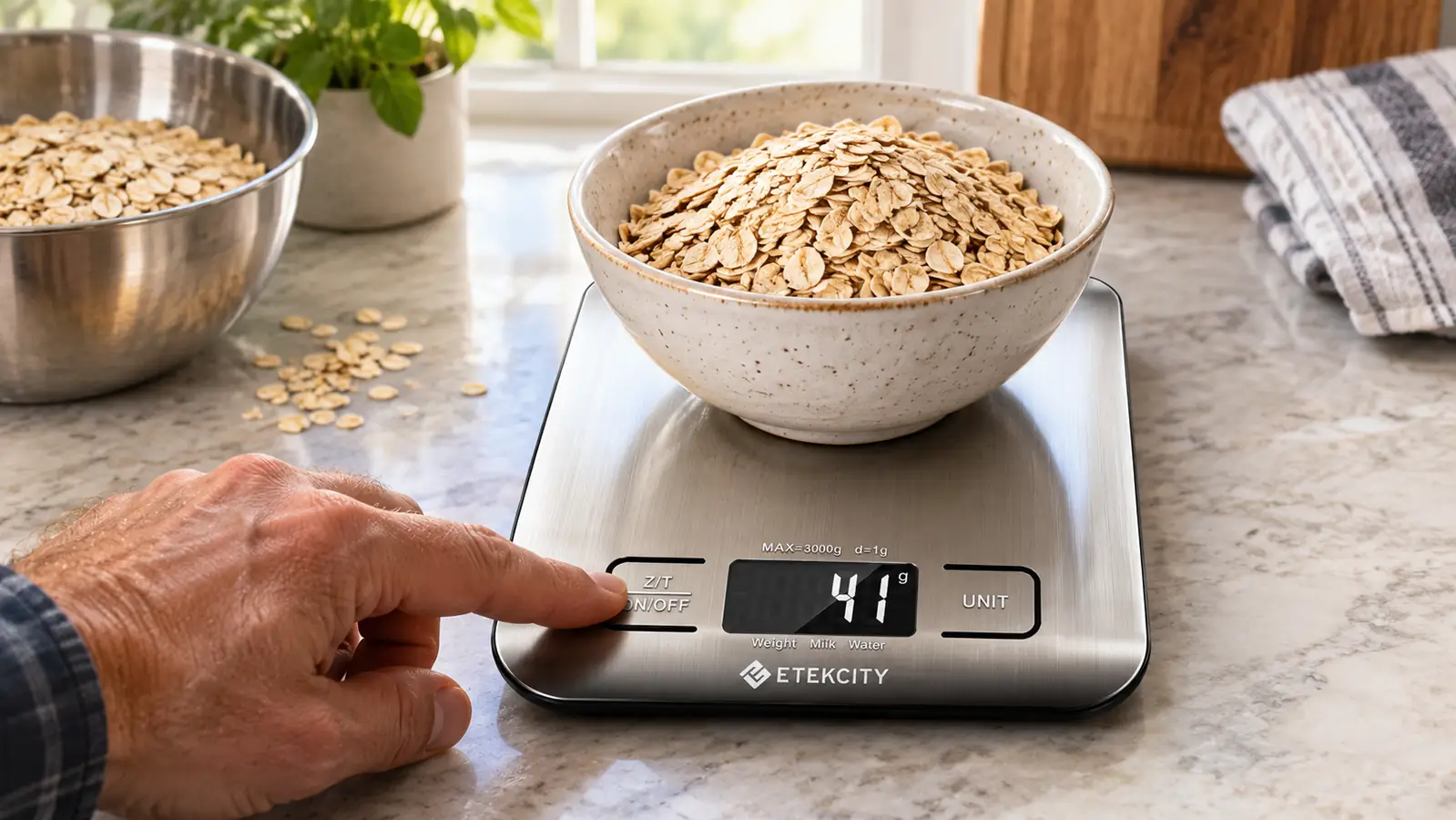
This is the step people skip, and it is the reason some folks decide a food scale is too much trouble. Set your bowl or plate on the scale first. Press the tare button. The display goes back to zero with the bowl still sitting there. Now anything you add reads as the weight of the food alone. No subtracting, no mental arithmetic while the oatmeal gets cold.
Tare again between ingredients. Bowl on, tare, add the oats, note the number, tare, add the milk, note the number. Same bowl, same spot, three readings. On the Etekcity the tare function is one button and the backlit display is easy to read even when the kitchen light is dim, which matters more at sixty-one than it did at forty.
One practical note. Put the scale on a hard, flat surface, not on a towel or a wooden board that rocks. Mine lives on the same square of counter beside the toaster, and after a couple of weeks my hand goes to the tare button without my looking.
Step 3: Switch to grams and stop doing fractions
Ounces and cups invite math. Grams do not. Half of three quarters of a cup is a small argument with yourself. Forty grams is forty grams. The scale reads in 1 gram increments, so there is no debate about whether you are close enough.
The scale handles five units, so you can flip between grams, ounces, pounds and ounces, fluid ounces and milliliters depending on what you are weighing. I use grams for food and milliliters for coffee. That is it. Dale uses ounces for his cereal because he is set in his ways, and the scale does not argue with him either.
The other thing grams did for me was make the old cookbooks usable again. Most of mine give amounts by volume, and volume changes depending on how you scoop. When a recipe called for a cup of flour, I weighed it once to see what my scoop actually produced: 138 grams on a light scoop, 162 on a packed one. Twenty-four grams is a real difference in a pan of muffins, and it explains why the same recipe turned out differently every single time I made it. Now I weigh the flour, pencil the number in the margin, and the recipe is settled for good.
The first week of grams feels fussy. The second week it feels normal. By the third week you will know what 30 grams of oats looks like in your own bowl without looking at the display, and that is the beginning of the whole point.
My cereal was nearly half again what I thought it was. I had spent a year calling that a metabolism problem.

Step 4: Weigh while you build the plate, not after it is built
Weighing a finished casserole tells you what the whole dish weighs. It does not tell you what is on your plate. So I weigh as I assemble. If I am making a plate of rice, chicken and vegetables, I tare the plate, add the rice, note it, tare, add the chicken, note it. Three numbers, thirty seconds, and I know exactly what I am eating.
Batch cooking is where this pays off most. Sunday I make a pot of vegetable soup that used to be a guessing game. Now I weigh the empty pot, tare it, and weigh the finished soup, which last week came to 2,140 grams. I filled four containers, weighing each one as I went, and each landed around 535 grams. That is four lunches of a known size instead of four lunches of whatever happened to fall off the ladle. When I reheat one at noon I am not estimating anything, and I am not hungry again at two.
For anything I eat out of a bag, pretzels, almonds, crackers, I set a bowl on the scale first, tare, and pour until the number stops where I want it. It is the only reliable way I have found to stop eating straight out of the bag, because the bag has no bottom and the bowl does.
You will notice the scale is small enough to leave out and easy to wipe down, which matters because raw chicken and oil both end up on it. The surface is food-grade stainless steel. A damp cloth, dry it, done. I have never once had to scrub it.
Step 5: Retire the scale for anything you have memorized
Here is the part nobody tells you. The goal is not to weigh food forever. After about six weeks of weighing the same five items, I could pour 40 grams of oats into my bowl with my eyes on the window instead of the display, and be right within a few grams. That is not a skill I was born with. It is repetition.
I will be honest about where it went sideways. Around the holidays I stopped weighing anything for about three weeks, telling myself I had it memorized. By the second week of January the cereal was back up near 55 grams, and I knew it without checking, because the bowl looked a little fuller than it should and I was eating it faster. So the scale came back out, I weighed for four days, and the number came back down. That is the cycle. I do not fight it anymore. When the portions drift, the scale comes back out for a few days and then goes quiet again.
So I stopped weighing the things I had learned and kept weighing the things I had not. New foods, restaurant leftovers I brought home, anything with oil or cheese in it, and anything I am eating straight out of a bag. The scale is on the counter maybe three times a day now instead of ten, and the habit holds because it never became a full-time job.
That is the whole method. Not discipline. A number, a bowl, and the willingness to look at it.
What Else Helps
Weighing is the piece that gets the numbers right, but it is not the whole of it. Three things made the biggest difference for me alongside the scale. The first was walking Mabel every morning, which started as a chore and turned into the part of the day I look forward to. The second was putting the food on smaller plates, because a normal portion on a big plate looks like a punishment and my brain is not above being tricked. The third was eating at the table instead of standing at the counter, which cut down on the unmeasured handfuls in a way I did not expect.
One more thing that helped: I stopped weighing myself more than once a week. Sunday morning, same time, same hallway, pencil on the calendar. Daily weighing made me reactive and moody, and reactive people do not stick with anything. Weekly gave me a trend instead of a mood.
And I want to say this plainly, because it matters more than any tip above. Talk to your doctor before you change how you eat or how much you move, especially if you take medication or manage a health condition. My own start came after my doctor flagged my blood pressure, and the conversation I had with her shaped everything after it. A scale is a tool. It is not advice, and it is not a diagnosis. What worked for me may not be what works for you, and nobody honest can promise you a number of pounds.
Start With One Week and Five Foods
You do not need a new diet next Monday. You need to know what a portion actually looks like in your own bowls. The Etekcity scale weighs up to 11 pounds in 1 gram increments, tares with your dish already on it, and fits in a drawer when you are done.
Amazon Check Today's Price on Amazon →