
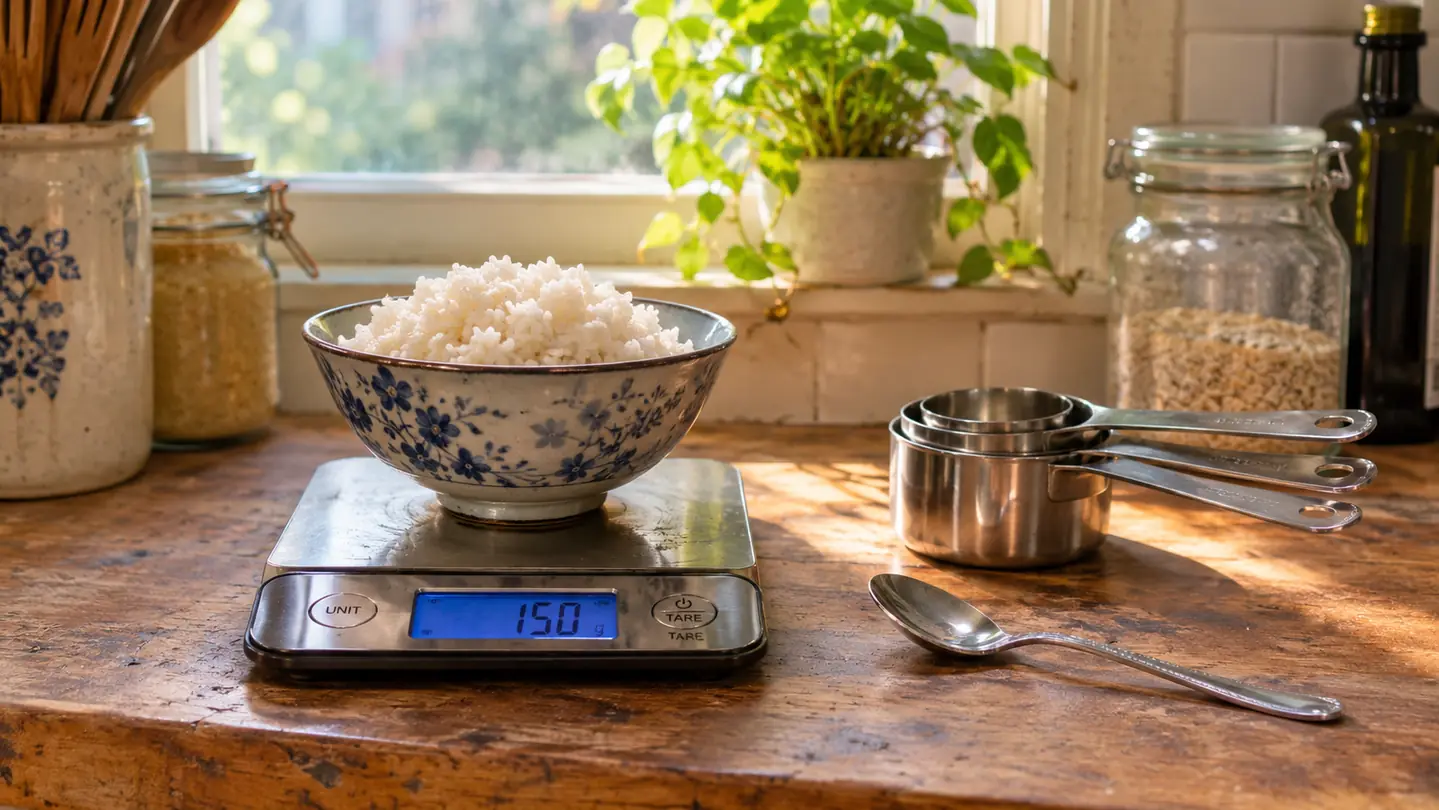
For two years I portioned every meal with a set of nesting measuring cups and a private belief that I could eyeball the rest. I would pack diced chicken into a quarter cup, shake it level over the sink, and call it four ounces. Then my husband Dale brought home an Etekcity digital kitchen scale, mostly to weigh coffee beans, and the first thing I put on it was that same quarter cup of chicken. It read 2.6 ounces. Not four. Not close. That single number is the whole argument between these two tools, and it is why both of them now live on my counter in Asheville instead of one being banished to a drawer.
Here is the short answer. Use the Etekcity scale for anything you eat with a fork, and keep the measuring cups for anything you drink or pour. Meat, rice, pasta, cereal, cheese, nuts and Mabel's kibble go on the scale. Milk for your coffee, oil for a pan and broth for soup go in a cup. The scale is the more useful of the two for portion control, and I will say that plainly, but it is not better at everything. A comparison that declares one winner in every category is not a comparison, it is an advertisement, and you can usually tell from the first paragraph.
| Etekcity Food Scale | Measuring Cups | |
|---|---|---|
| Precision | Reads in 1 g increments, so the chicken that looks like a portion gets a number instead of an opinion | A quarter cup of diced chicken swung between 2.6 and 3.6 ounces depending on how tightly I packed it |
| Capacity | Weighs up to 11 lb / 5 kg in one go, enough for a full batch of dough or a pot of stew ingredients | A standard nesting set tops out around 4 cups, so a big batch means stopping and refilling |
| Tare | The tare button zeroes the bowl, so I add rice, zero again, add beans, zero again, and dirty one dish | No equivalent. Scoop, level, dump, then start the whole ritual over for the next ingredient |
| Liquids | Has fl oz and mL modes, but you are still reading a volume off a weight | A glass cup with a pour spout is what a cup of milk actually wants |
| Power | Runs on two AAA batteries, which come in the box | Nothing to power and nothing to fail at seven in the morning |
| Cleanup | Wipe the 304 food grade stainless platform with a damp cloth, do not dunk it | Most sets go straight in the dishwasher |
| Learning curve | About a week of thinking in grams before it stops feeling like homework | You have known how to use these since you were nine years old |
| Units | oz, lb: oz, fl oz, g and mL, all in one tool | Cups, tablespoons, teaspoons and fractions |
| Storage | Small and compact, it lives in the drawer with the spatulas without a fight | Nesting sets take up a corner of a cabinet and the lid never quite fits back |
| Best for | Anything you eat with a fork | Anything you drink or pour |
How I Compared Them in My Own Kitchen
I did not run a lab. I ran a small kitchen where one side of the counter is level and the other is not, and I weighed and scooped the same foods with both tools for about three weeks. The test foods were the ones I actually eat: chicken breast, cooked rice, dry pasta, rolled oats, grated cheddar, almonds, and the scoop of kibble Mabel gets at six o'clock. I wrote down what the scale said and what a level quarter cup or half cup said, and I noted anywhere the two disagreed by more than a rounding error.
The disagreements were not small. Grated cheddar was the worst offender, because how tightly it packs changes everything, and a half cup could swing by nearly an ounce depending on whether I scooped or spooned. Dry pasta held up better in a cup since the shapes are fairly uniform. Rolled oats landed somewhere in the middle. Chicken was a coin flip, and cooked rice was hopeless in a cup. I have been cooking for forty years and I was still surprised by how much of that was guesswork wearing a confident face. I kept the notes in a spiral notebook on the windowsill, one line per food, dated. Looking back at the page from the second Tuesday, the cheddar entries run from 1.9 ounces to 2.6 ounces for the same half cup, which is a swing of more than a third from nothing but how I moved my wrist. Nobody's dinner deserves that much drama.
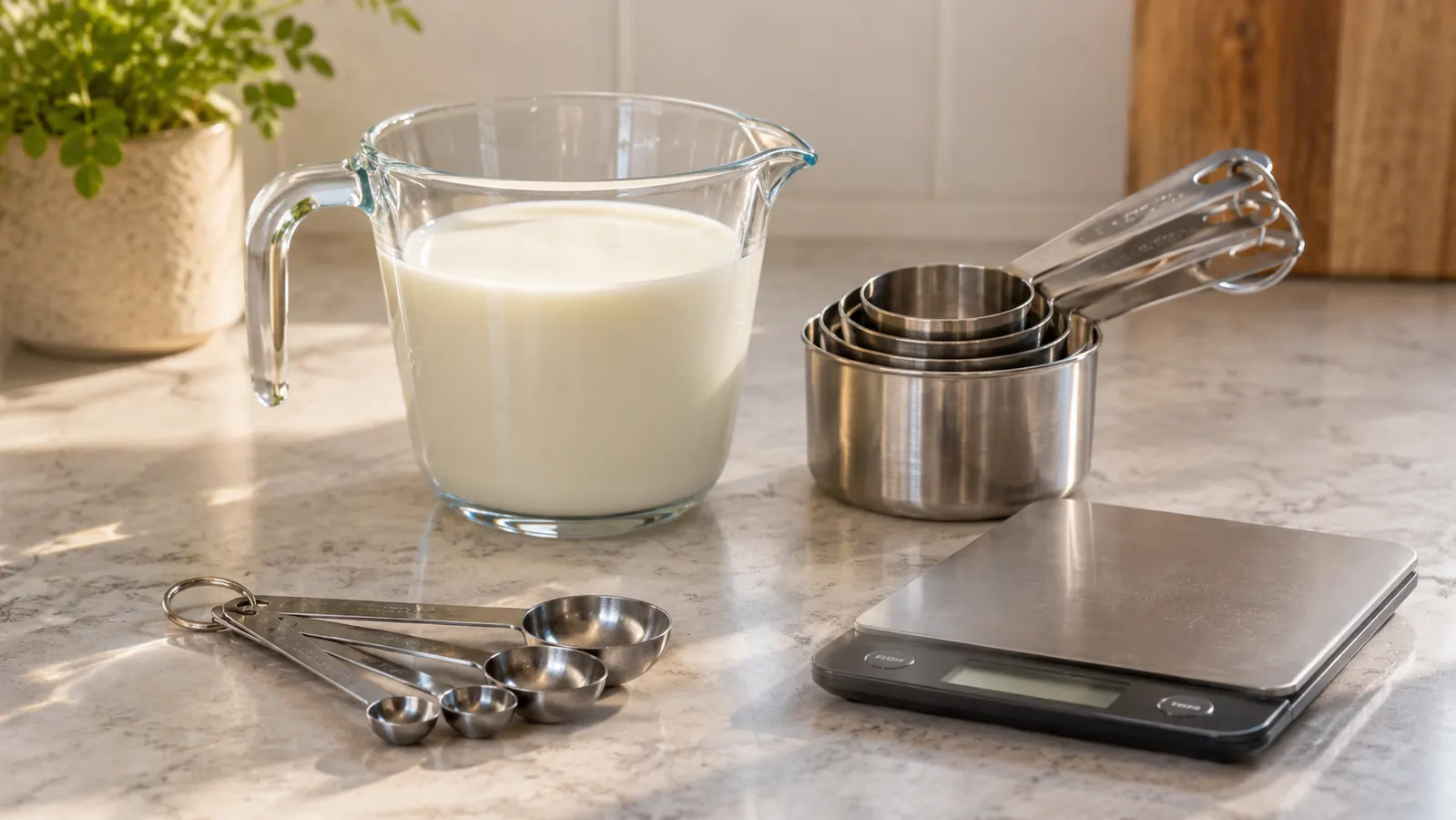
The cups, to be fair, never failed me on liquids. A cup of milk in a glass measuring cup with a spout is exactly the job that tool was built for, and pouring milk onto a scale to read it back in fluid ounces is extra work for the same answer. The scale also has a learning curve. The first week I kept converting grams to ounces in my head and getting irritated. By the second week my hands knew what a portion of almonds looked like, and that is the point where the tool stopped feeling like arithmetic and started feeling like a habit.
Where Etekcity Wins
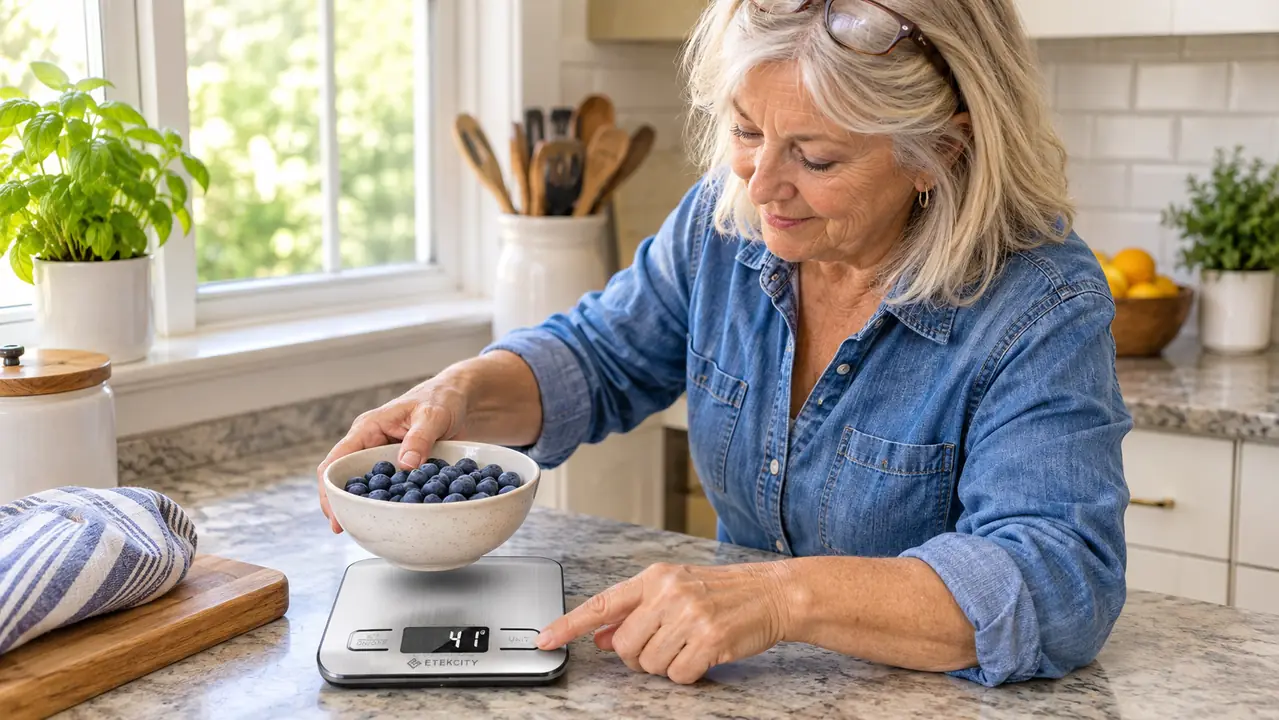
The Etekcity scale wins on precision, and precision is the entire reason to own it. It reads in 1 gram increments up to 11 pounds or 5 kilograms, so a portion of chicken is a number rather than a guess, and a portion of almonds comes out the same on Tuesday as it did on Saturday. The tare button is what makes it work in a real kitchen with real dishes. I set my bowl on the platform, press tare, add rice, press tare, add beans, press tare, and I never dirty a second bowl. Measuring cups cannot do that. With cups you scoop, level, dump, and begin the ritual again.
The second win is range. Five units cover the way I actually cook: ounces, pounds and ounces, fluid ounces, grams and milliliters, and the backlit LCD with its large fonts is readable at six in the morning without my glasses, which at sixty-one is not a small thing. The capacity handles a full batch of dough or a whole pot of stew ingredients without stopping halfway through. And the platform is 304 food grade stainless steel, so it wipes clean in seconds with a damp cloth and does not hold onto the smell of garlic the way plastic does. I use it for Mabel's kibble too, which sounds fussy until you have tried to keep a seventy pound dog's dinner consistent through a change of bag. Sixty grams in the morning, sixty grams at six o'clock, and the plastic scoop that came in the bag is retired to the garage. When I bake bread the whole mixing bowl sits on the platform and the steel does not flex under the weight.
Where Measuring Cups Win
The cups win on liquids, and they win by a lot. Fluid ounces on a scale are still a weight measurement wearing a volume label, and if you have ever tried to weigh milk into a tall pot balanced on a small platform you know how quickly that stops being reasonable. A glass cup with a pour spout does the job in one motion. The cups also go in the dishwasher, which the scale does not, and the scale's own instructions are clear that the platform gets wiped rather than washed. After three weeks of daily use there is a fine film of flour under the front edge of mine that I cannot reach without a brush. I tried a damp paper towel folded to a point, then a chopstick wrapped in cloth, then gave up and accepted it. On a Sunday when Dale and I make soup, the cups go in the bottom rack and I am finished with them. The scale has to be wiped between ingredients, and the wiping has to happen with the platform flat, which means clearing counter space I do not always have.
The last thing the cups win is familiarity. Nobody needs a tutorial for a quarter cup. The scale asks you to think in grams for about a week, and some people never get past that, which is fine. I spent thirty years as a school librarian and I like a system with a key printed on it, but I also know that not everyone does. My friend Nadine borrowed mine for a weekend, weighed two things, and handed it back saying it made her feel like she was doing taxes. That is an honest reaction and it deserves respect. A tool you will not use has no advantages at all, whatever its accuracy says on the box.
A quarter cup of chicken is an opinion. 2.6 ounces is a fact. The scale is the only tool in my kitchen that tells me which one I am dealing with.
Weigh the chicken once and stop guessing what a quarter cup holds
The Etekcity digital kitchen scale reads in 1 g increments up to 11 lb, tares a bowl to zero with one button, and runs on two AAA batteries that come in the box. It is the tool I reach for before anything I eat with a fork.
Amazon Check Today's Price on Amazon →What I Liked
- Reads to 1 g, so a portion stops being a guess
- The tare button lets me weigh three ingredients in one bowl
- Five units, including oz, lb: oz, fl oz, g and mL
- 11 lb / 5 kg capacity handles a full batch of dough
- Backlit LCD with large fonts, readable before coffee
- Small and compact, it stores in the utensil drawer
- Stainless platform wipes clean in a few seconds
Where It Falls Short
- Runs on two AAA batteries, so it will eventually die at an inconvenient moment
- Not dishwasher safe, it is strictly a wipe-down tool
- Crumbs collect under the front edge of the platform
- The fluid ounce mode is still a weight reading dressed as a volume
- Takes about a week before grams feel like a normal language
- The platform is small, so a wide bowl needs centering carefully
The Test That Changed How I Cook Rice
Cooked rice was the moment I stopped arguing with myself. I used to serve a rounded half cup and write it down as a cup, because it looked like a cup and I wanted it to be one. On the scale that same scoop came closer to six ounces cooked. When I weighed out four ounces instead, the difference in my evening was noticeable in a way that had nothing to do with hunger and everything to do with paying attention. That is not a weight loss promise, and I am not going to make one. It is just what happened when the number stopped being flattering. I wrote down both figures in the notebook for two weeks, the cup number and the scale number, side by side, and the gap never closed. It ran between an ounce and a half and three ounces every single night, which over a week is a couple of extra servings I had no idea I was eating.
The same thing happened with pasta. A two ounce serving of dry penne in a measuring cup is roughly three quarters of a cup, but only if the pieces stack the same way twice, and they never do. On the scale it is two ounces every time, in about four seconds. I still use a cup for the milk in my coffee and the oil in the pan. I still use cups for stock, and for rice when I am cooking for four instead of one. The scale handles the food that decides how the meal goes, and the cups handle the things I could pour with my eyes closed. Dale noticed the rice before I said anything. He asked whether I had changed something about it, and I had, by about two ounces a plate. That is the sort of difference that only shows up on a scale, because it is invisible in a measuring cup and invisible to your own eye.
A Word About the Numbers
One caution, and I mean this sincerely. Nothing about a kitchen scale is medical advice. If you are managing a health condition, taking medication that affects appetite, or you have any history of disordered eating, talk to your doctor before you start weighing food, and be honest with yourself about whether daily numbers settle you down or make you anxious. I asked my own doctor about it at a regular visit, plainly, and she said the same thing back to me in fewer words: the tool is neutral, the person holding it is not. For me the numbers have been steadying, because a figure I can check is calmer than a guess I have to defend to myself at nine at night. For someone else it could be the exact opposite, and that person should keep the cups and skip the scale without a second thought.
Who Should Buy Which
Buy the Etekcity scale if you are portioning food you eat with a fork and you want the same answer twice. Buy it if you cook for one or two, if you are trying to be honest about cheese and nuts and rice, if you bake by weight, or if you want to stop guessing how much kibble goes into the bowl. It is also the better tool if you like the idea of one bowl for a whole recipe, since the tare button means you are not washing three measuring cups afterward. It weighs in grams and ounces, holds up to 11 pounds, and stores in a drawer.
Keep your measuring cups, and skip the scale, if you mostly cook from recipes written in cups and you are happy with how the food comes out. Cups are also the right call if daily numbers make you tense, or if you are cooking a big pot of soup and simply need roughly a cup of this and a cup of that. Most kitchens end up with both, and that is not a failure of discipline. It is a drawer that reflects how you actually cook, which is the only standard that matters over a couple of years of ordinary weeknights.
One tool, one bowl, and a number you can check twice
The Etekcity scale weighs up to 11 lb in 1 g increments, tares with a single button, and wipes clean in seconds. Keep the cups for the milk. Use the scale for everything else.
Amazon Check Today's Price on Amazon →