
I did not want to like the Etekcity food scale. I wanted it to be one more small gadget that lives in a drawer next to the garlic press, and I wanted to go back to eyeballing a cup of rice the way my mother did. That is not what happened. Two years into measuring my food, this is the only kitchen purchase I have never once regretted, and the honest review nobody writes is this: the scale is the easy part. Everything difficult about portion control happens in the ten seconds before you turn it on.
I am 61, retired from a school library in Asheville, and I started changing how I ate in my late fifties after my doctor raised an eyebrow at my blood pressure. I am not a nutritionist and I am not going to tell you what to eat. Talk to your doctor before you change your diet or your exercise, especially if you take medication or manage a health condition. What I can tell you is what a small digital scale did in an ordinary kitchen over a couple of years, and what it did not do.
A word on the shape of this review, since it is an honest review and not a product page. Nobody sent me this scale and nobody paid me to write about it. What I care about with any kitchen tool is whether it still works and still gets used two years later, because plenty of things survive the first month and then quietly stop.
The Quick Verdict
Accurate to a single gram, small enough to leave out, and boring in the best way. The eleven pound limit and the missing memory are real tradeoffs. It has earned its counter space in this house.
Amazon Check Today's Price →The scale that never made it into the drawer
Two years on the counter, thousands of bowls, one battery change. If you want to know what a portion actually weighs, this is the plainest way to find out.
Amazon Check Today's Price on Amazon →How I've Used It
The scale came into the house on a Tuesday, which I remember because Dale asked what was in the box and I told him it was for the dog. That was half true. Mabel is our seven-year-old retriever-shepherd mix, she sits around seventy pounds and needs a long walk every day, and I had started measuring her kibble because I could not tell one scoop from another.
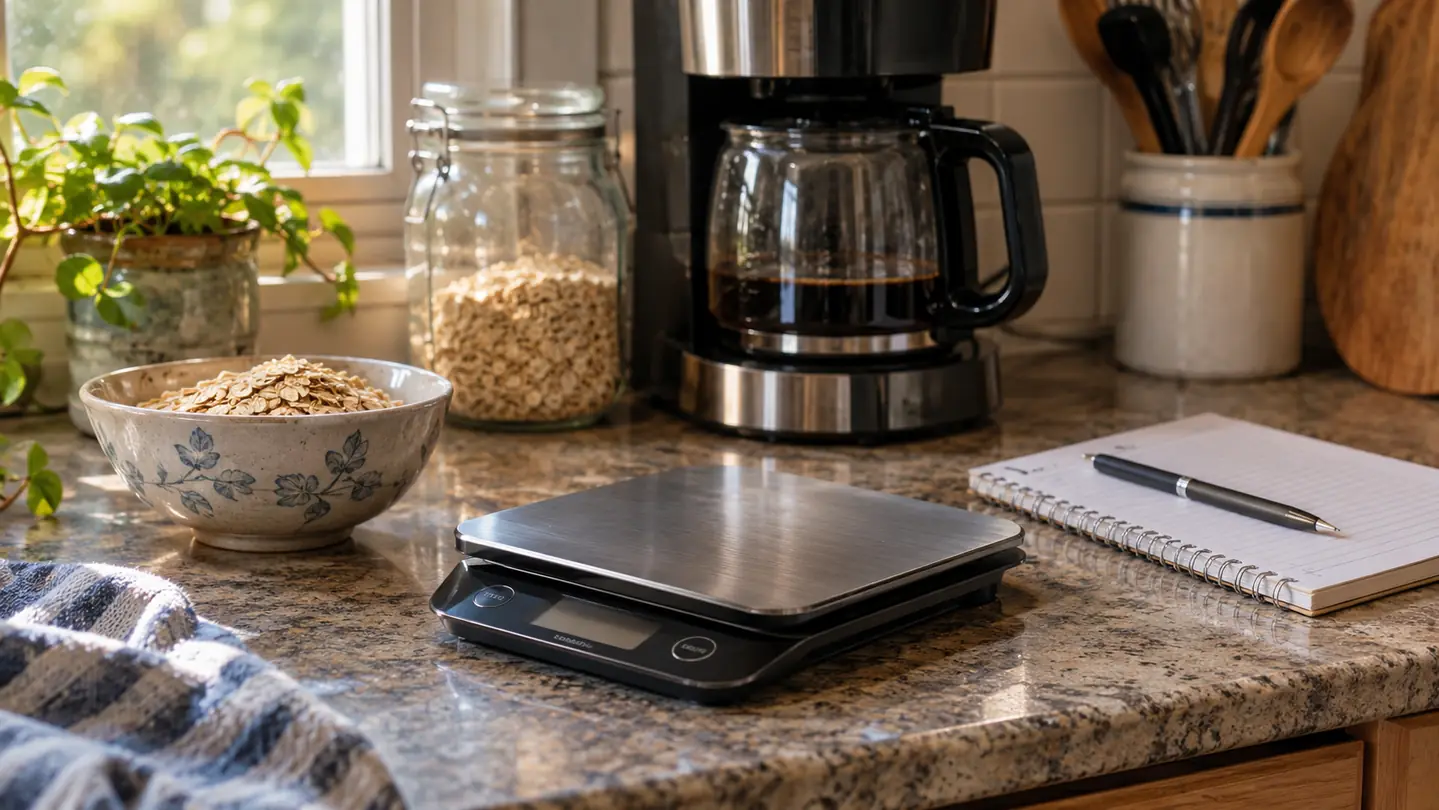
For me it went on the counter beside the coffee maker and stayed there. I weigh oatmeal in the morning, yogurt and berries at lunch, and whatever goes on the plate at dinner. I weigh cheese, which was a small tragedy. I weigh the oil I cook with, because pouring oil by eye is the easiest way I know to add a few hundred calories without noticing a thing.
The first Saturday I had it, I weighed out rice for a pot of something and got a number that surprised me enough to write it on the back of an envelope. I had been using a measuring cup that held closer to a cup and a quarter than a cup, and I had been using it for years without a second thought. I still have that envelope stuck to the fridge. It is a small, unremarkable record of a habit changing, and it is more useful to me than any app I have ever downloaded and abandoned.
Two years of that is probably two thousand times I have set a bowl down and pressed a control. That is the kind of repetition that finds a weakness in a product, and it found a few. But I want to be fair about what this thing is. It is a small digital kitchen scale that weighs what you put on it. It does that job and it does not do anything else.
What Nobody Tells You About Food Scales
A food scale does not make you eat less. It makes you aware of what you were already eating, and awareness is deeply annoying for the first week or so.
In that first week I learned that my usual bowl of granola was roughly double what the side of the bag called a serving. I learned that the handful of nuts I carried to the couch was three servings by weight. I learned that I had been estimating pasta by the shape of the pile, and my estimates ran about a third low every single time. None of that is the fault of the scale. All of it is the doing of the scale.
By the end of that first week I had weighed the same granola three mornings in a row just to see whether I was consistent. I was, to within two or three grams. That was oddly reassuring, because it meant the scale was telling me the truth and the problem was the portion, not the instrument. I also weighed a banana whole, then peeled, then peeled and sliced, mostly out of curiosity. The differences were small enough that I stopped fussing about which way I did it and got on with breakfast.
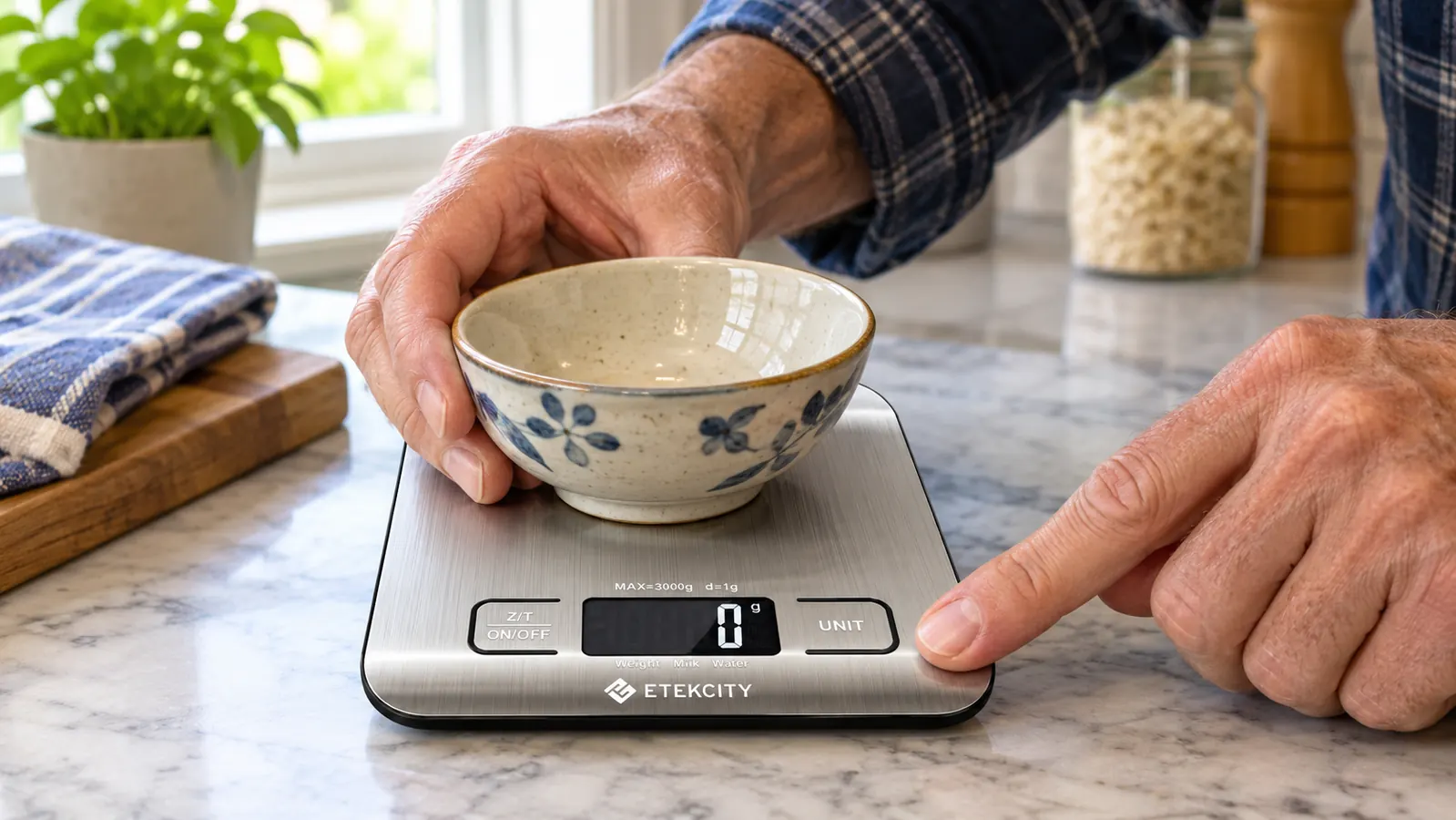
The second thing nobody mentions is that the tare function is the whole product. You set the bowl down, you press tare, the display returns to zero, you add food, you read the number. If that little sequence feels clumsy, you stop doing it, and the scale goes in the drawer. On this one the sequence became habit within a week, which is the most useful thing I can say about any kitchen tool.
The third thing is that the habit drifts. Not the accuracy, the habit. I stopped weighing for about a month last spring, and when I came back my portions had crept up by roughly a tenth across the board. I did not gain a dramatic amount. I noticed, and I noticed because the scale was there to tell me. A scale in a drawer cannot do that, and that is true of every model ever made, not just this one.
My pasta estimates ran about a third low every single time. The scale did not change my willpower. It changed my arithmetic.
What It Actually Does, Plainly
The Etekcity scale weighs up to eleven pounds, or five kilograms, in one gram increments. That is the engine of the whole thing. One gram is finer than any home kitchen needs. It is fine enough that you can watch the number move when you add four almonds.
It reads in five units: ounces, pounds and ounces, fluid ounces, grams, and milliliters. I use grams and pounds and ounces, and I ignore the other three. Fluid ounces and milliliters are there for liquids, though I would rather weigh milk than measure it by volume. That is my preference and not a fault in the scale.
The sequence I use most is the boring one. Bowl on the platform, press the control that returns it to zero, add food, read the number, then set the whole thing back beside the coffee maker without touching anything else. Two years of that and my thumb knows the layout without my looking at it. That is not a line on any listing, but it is the reason the tool actually gets used instead of admired.
The display is backlit, with large characters, and it is genuinely easier to read at six in the morning than the tiny window on the scale I owned before this one. The interface is a tare control and a unit control and nothing else. No app, no memory, no profiles, nothing to set up and nothing to pair. If you are the kind of person who reads a manual, you will not need this one for long.
The platform is 304 food grade stainless steel and wipes clean with a damp cloth. Nothing has stained it, including turmeric, which permanently marked two of my plastic cutting boards. The body is small and light, right around seven ounces, so it can live on a crowded counter or slide into a drawer. Mine has never gone in the drawer.
It runs on two AAA batteries, and they come in the box already installed. I have replaced them once in two years, and I am not certain that replacement was necessary.
Where It Surprised Me
The first surprise was the low end. I expected a scale this small to be vague with small amounts, and it is not. It registers a single gram, and the number is steady rather than flickering between two values the way the scale I owned in the nineties did.
The second surprise was the footprint. It sits between the coffee maker and the toaster without crowding either, and I can still set a mixing bowl on it and read the display past the rim. I assumed I would be hauling it out for anything bigger than a cereal bowl. I have not hauled it out once.
The third surprise has nothing to do with my own food. I weigh Mabel's kibble, obviously. But I also weigh rice before it goes in the pot, coffee beans on the weekends, and once a stack of quilt batting I was trying to divide into even pieces. The listing says the Etekcity scale is meant for food, fruit, jewellery, medicines and pets, and I laughed when I read that list. I have now used it for three of those five.
The fourth surprise was cheese, which I mentioned earlier and which deserves its own line. Grating a block of sharp cheddar and weighing it changed my pasta more than any sauce recipe I have ever tried. Forty grams goes further than I believed it would, and my old habit of grating until the block looked short was costing me a good hundred calories a plate. That is a genuinely useful discovery and it came from a kitchen scale, which is a sentence I never expected to write.
Where It Falls Short
Eleven pounds is not a lot. It is plenty for a plate, a bowl, or a batch of dough. It is not enough for a stockpot of chili or a turkey, and I have hit the ceiling twice. Both times I had to weigh in two batches on a dinner plate, which is fiddly and costs you the tare. If you cook in big volumes, this is the wrong scale for you.
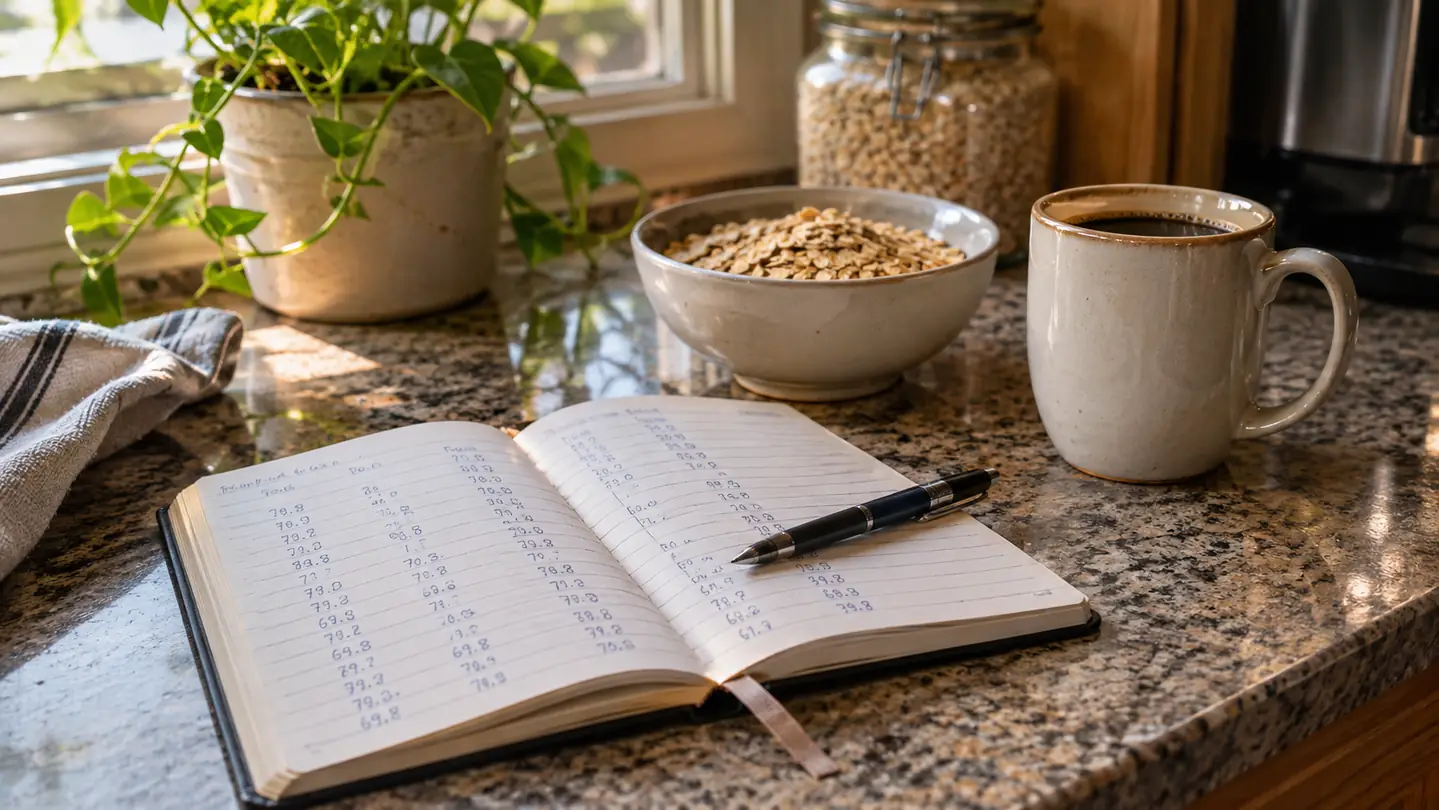
There is no memory and no way to recall a reading. If you want a record of what you weighed, you write it down. I use the back of an envelope stuck to the fridge with a magnet, which is as primitive as it sounds. It is also why I have never had to troubleshoot this thing.
The stainless platform shows every fingerprint and every smear of butter. It wipes clean in two seconds, but you will be wiping it, often. The controls are also easy to catch with a thumb when you move the scale across the counter, and I have set the unit to fluid ounces by accident more times than I can count. I usually do not notice until a number looks strange.
And here is the honest one. A scale cannot tell you what to eat. I have weighed a portion of potato chips to the gram and eaten it, and I have also weighed a portion and then gone back for a second weighed portion. The scale is neutral. It only tells you the truth about what you are doing, and some days the truth is not what you wanted to hear.
What I Liked
- Accurate to one gram and steady at small amounts
- The tare function becomes second nature within a week
- Compact and light enough to leave on the counter permanently
- Backlit display with large characters reads easily in a dim kitchen
- 304 food grade stainless platform wipes clean in seconds
- Five units including grams, pounds and ounces, fluid ounces and milliliters
- Batteries come installed and lasted about two years here
Where It Falls Short
- Eleven pound maximum rules out stockpots and bulk bags
- No memory, so any record has to be written by hand
- The platform collects fingerprints and needs frequent wiping
- Easy to bump the unit control and change readings by accident
- Not designed for large volume or batch cooking
The Part That Has Nothing to Do With the Scale
I lost weight slowly over a couple of years. I am not going to give you a number, because my number is mine and yours will be different, and because what happened to one 61-year-old retired librarian in North Carolina is not a promise about anyone else. The scale was one of three changes, and it was the smallest and least dramatic of them.
The other two were walking Mabel every morning whether or not I felt like it, and changing what lives in my kitchen so that the easy thing to reach is also the thing I want to be eating. None of those three is interesting. None of them would make a compelling advertisement. Together they have done more for me than every diet I tried in my forties.
I say all of that because people buy a food scale expecting it to be the thing that changes everything, and then they are disappointed when it turns out to be a scale. It is a scale. It is a good one, accurate and small and boring. The changing is yours. Talk to your doctor before you start, and then start with something you can actually keep doing on a Thursday in February.
Who This Is For
This is for someone who wants to know what a portion actually weighs and is willing to spend a few seconds per meal finding out. It suits a kitchen with limited counter space and a household of one or two. It suits anyone who has measured cereal into a bowl by feel and quietly suspected they were lying to themselves. It also suits anyone feeding a pet by weight instead of by scoop, which is how it started in this house.
If you are early in changing how you eat, I would tell you to see your doctor first and then buy the least complicated scale you can find. The Etekcity qualifies. The features that matter are accuracy and the tare function, and it has both, and nothing else about it is complicated enough to learn.
Who Should Skip It
Skip it if you cook in big batches. A pot of soup, a stockpot of stock, a ten pound bag of flour: none of that fits inside eleven pounds or on a platform this size, and you will be happier with a larger scale that has a removable platform.
Skip it if you want your meals logged automatically. There is nothing here to pair and nothing to sync and no history to review. If tracking on your phone is what keeps you honest, buy a scale built for that and expect to pay accordingly.
And skip it if you know yourself well enough to know the scale will end up in the drawer. I am not being cute about this. A scale in a drawer is not working, no matter how accurate it is on the counter. Mine has never gone in the drawer, and that is the entire reason it has been worth owning.
If you are going to weigh your food, weigh it on something you will keep out
Accurate to a gram, small enough for a crowded counter, and simple enough that you will still be using it in two years. That is the whole case for it, and it is the only case I have.
Amazon Check Today's Price on Amazon →