
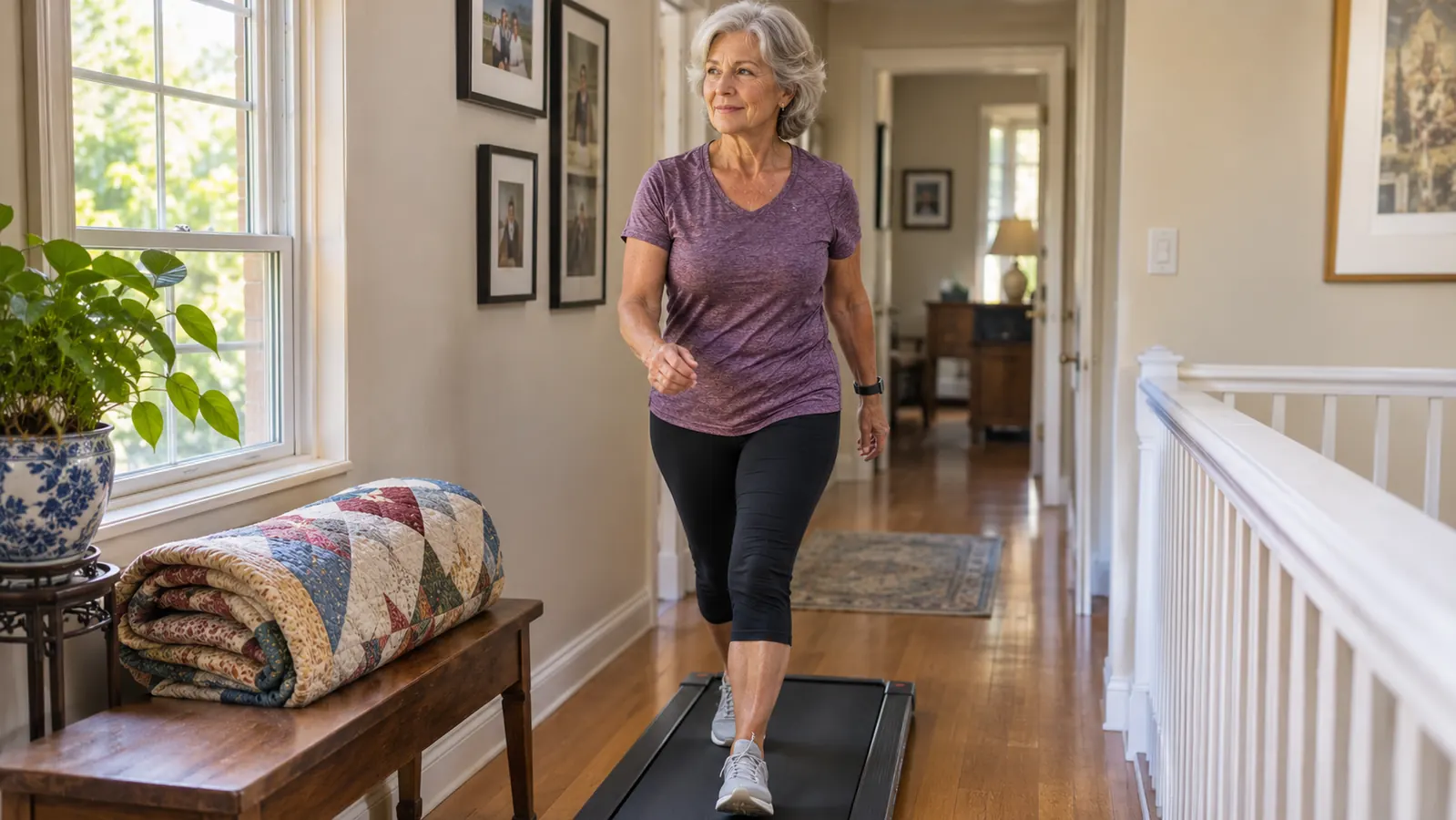
I have a hallway in a two-bedroom house in Asheville that is barely wide enough for two people to pass, and that hallway is where the UREVO walking pad lives. Not under a standing desk. Not in a home gym, because I do not have one. In the hallway, pushed against the wall when it is not in use, which is more often than the product photos would suggest. I am telling you that first because the honest version of a walking pad review is mostly a review of your house. The machine itself is well built. Whether it fits your life is a different question, and it is the one the listing never answers.
Some context on me. I am 61, a retired school librarian, and I started changing my habits in my late fifties after my doctor raised a flag about my blood pressure. I walk my dog Mabel, a seventy-pound retriever-shepherd mix, every single day. That walk is the backbone of everything else. The walking pad is what I use when the backbone is unavailable: ice on the sidewalk, a downpour, the dark at five in the afternoon in January. If you are looking for a machine to replace your walks, this is not it. If you want one that keeps you moving when the outdoors refuses to cooperate, it is worth a careful look, including the parts I did not enjoy.
The Quick Verdict
A stable deck, a real 11 percent incline, and a motor that handles walking speeds without complaint. The app is far more than I need, and the marketing around it is more enthusiastic than the machine warrants.
Amazon Check Today's Price →The incline is the reason this one earns its floor space
Most pads in this category are flat. The UREVO adds an 11 percent manual incline, a 0.6 mile per hour starting speed, and a deck that stays put while you walk. Check the current price and the full spec sheet on Amazon.
Amazon Check Today's Price on Amazon →How I've Used It
I have used the UREVO almost every week since it arrived, in sessions of twenty to forty-five minutes, at speeds between 1.5 and 3.0 miles per hour. The machine runs from 0.6 to 6.2 miles per hour, so I live in the bottom third of it. That is deliberate. I am a walker with a stiff hip and a dog, not a runner, and the purpose here is to add steps on the days I cannot get them outside.
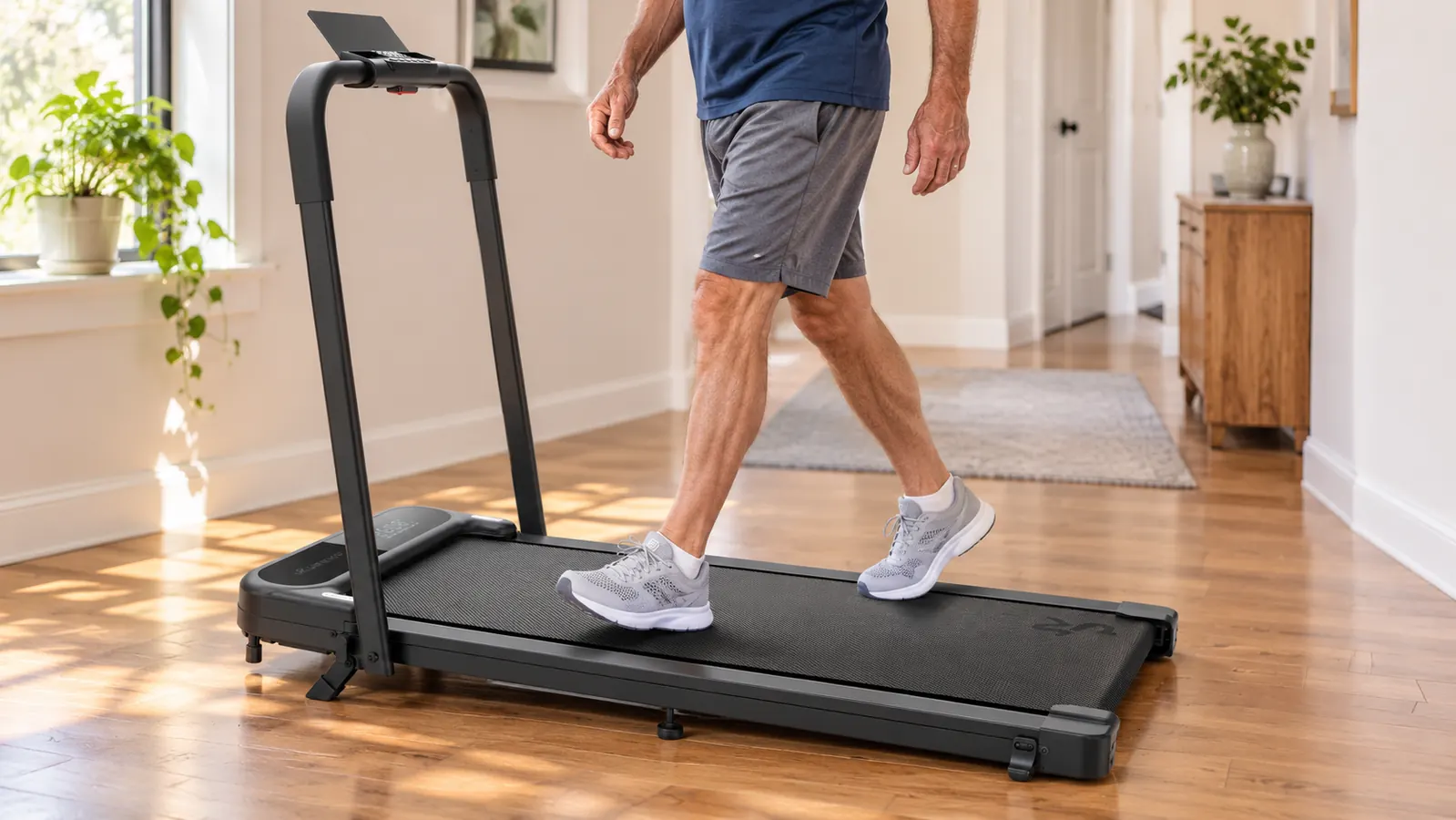
In plain numbers: the deck is 45 inches long, 22 inches wide, and just under 4 inches tall, and the whole thing weighs 43 pounds. It runs on a 2.25 horsepower motor with a maximum user weight of 265 pounds. There is an LED display for speed and time, and it pairs over Bluetooth with the UREVO Fitness App. I checked every one of those against the listing after a few weeks, because I have bought gadgets that quietly missed their own spec sheet. This one did not.
The one thing no listing says plainly is that this is a deck with nothing to hold onto. It sits a few inches off the floor, you step on, and you walk. For the first week I kept reaching for a handrail that does not exist. If your balance is not what it was, that matters more than any feature on the box, and I will come back to it.
Setup was about fifteen minutes and one person. The box held the pad and a user manual, and I read the manual, because I am a retired librarian and that is simply who I am. Unpacking it is the heaviest part of ownership. If your hallway is upstairs, recruit someone for the stairs and save your back for walking.
What Nobody Tells You About a Walking Pad in a Small House
The first thing nobody tells you is that a walking pad is furniture. It is 43 pounds of furniture that lives on your floor. I move it from the wall to the middle of the hallway and back, twice a day at most, because moving it more often turns a twenty-minute walk into a chore with extra steps. Dale helped me the first week. Now I do it alone and it is manageable. I would not want to carry it up a flight of stairs every evening, and if that is your plan, plan again.
The second thing is that walking indoors is duller than walking outside, and no amount of scenic app content fully fixes that. Mabel is not on the pad with me. There is no squirrel, no neighbor to wave at, no hill to complain about. What the pad has that the sidewalk does not is convenience, and convenience turns out to be enough on a rainy Tuesday. It is not enough on a sunny one, and it should not be.
The third thing is the belt. It collects dust and dog hair, because everything in this house collects dog hair, and I wipe it down every couple of weeks with a barely damp cloth. Mine sits on the wood floor rather than on a rug, because a moving belt on a soft surface never felt settled to me. That is my preference rather than a rule, but it is worth deciding before the pad arrives rather than after.
The fourth thing is sound. It is quieter than I expected, quiet enough that Dale can watch a basketball game in the next room without reaching for the volume. That is at walking speeds. If you push it toward the top of its range it makes more noise, as anything with a motor will. I rarely get near the top of the range, so this has not been a problem for us.
Forty-three pounds is light enough that I can move it alone, and heavy enough that I do not move it twice a day. That single number shaped my routine more than any app feature.
The Parts That Genuinely Work
The deck is stable at walking speeds. At 2 or 3 miles per hour I am not conscious of the belt at all, which is exactly what you want from a surface you are standing on. The 2.25 horsepower motor does not strain or surge. It simply turns. After months of use the belt still tracks straight and I have not had to adjust a thing.
The bottom of the speed range is the part I did not expect to care about. The pad starts at 0.6 miles per hour, slow enough to be a real warm-up. On mornings when my hip is stiff I start there and stay there for five minutes before I touch anything else. A pad that starts at a full mile per hour has you walking faster than your body wants before you have decided anything.
The incline is the reason I would pick this one again. The deck rises to 11 percent, and you set it by hand rather than with a button while you walk, which means you decide before you start and then live with your decision. Eleven percent is steeper than it sounds. I use it in blocks of four or five minutes and my heart rate notices every time. Flat walking on a pad is fine. Inclined walking on a pad is the part that feels like it is doing something.
And the size is right for what it is. At 45 inches long it fits across the end of my hallway with room to step around it. At 22 inches wide I am not worried about catching the edge. Nothing about the footprint surprised me, and in a small house, no surprises is the best possible outcome.
The Parts I Had to Get Used To
No handrail, as I said. The first two weeks I walked slower than I needed to because I did not trust my balance on a moving belt. That resolved, and it resolved because I started at 0.6 and worked up slowly, not because I got braver. If you have a balance issue, a history of vertigo, or a medication that leaves you lightheaded, this is the paragraph to take seriously. It is also a conversation for your doctor, not for me.
The top speed is 6.2 miles per hour and the deck is 45 inches. That is a jog for some people and a sprint for me, and I would not buy this to run on. It is a walking machine that can be pushed faster, and the distinction matters if you are shopping for something to jog on indoors.
The display is LED and it sits low at the front of the deck, so reading it means looking down and slightly ahead. In a hallway that is fine. If you were planning to put this under a standing desk, you would be reading it through the desk, which means you would end up using the app on your phone instead. I do not own a standing desk, so that is a guess rather than a complaint. Think it through before you buy.
The 265 pound weight limit deserves saying out loud. It is generous for a walking pad this thin, but it is a limit, and if you are anywhere near it, a heavier machine with a wider deck is the safer choice for you. Check that line on any spec sheet before you decide, not after.

The App, the Incline, and the Things I Ignore
The UREVO pairs over Bluetooth with the UREVO Fitness App, which shows your walk and offers routes and terrain settings that adjust the machine as you go. I set it up. It worked on the first try, which is more than I can say for most things that talk to my phone. I have used it maybe four times since.
The route feature is pleasant in a screensaver way, and I understand why someone walking forty minutes a day would enjoy it. I walk in a hallway. I already know what the hallway looks like. If you are the kind of person who likes a guided session, the app is well made. If you are the kind of person who presses start and thinks about something else, you will forget it exists, and the machine works fine when you do.
There is also an auto-speed mode that changes the belt for you. I tried it once, found it unsettling to have the floor change under me without my asking, and turned it off. That is a preference and not a defect. Some people will love it. I want to be the one who decides when the belt moves.
What I Liked
- Deck stays stable through walking speeds, from 0.6 up to about 3 miles per hour
- A real 11 percent incline, set by hand before you start
- Starts slow enough for a genuine warm-up on stiff mornings
- 43 pounds and just under 4 inches tall, so it stores against a wall
- Quiet enough that the next room can watch television
- Bluetooth pairing with the UREVO app worked on the first attempt
Where It Falls Short
- Nothing to hold onto, which is a serious consideration after 60
- Incline is manual, so you cannot change it mid-walk
- The 45 inch deck makes this a walking machine, not a running one
- The app is more elaborate than the machine needs
- The belt collects dust and dog hair and needs regular wiping
What a Normal Week Looks Like
Mabel gets her walk first, always. She is seven and she knows the schedule better than I do, and no machine is going to replace a dog standing by the door with her eyebrows up. The pad comes out on the days the weather or the light says no, and on two or three evenings a week when I have been sitting too long and want to close the day with twenty minutes of something.
Dale uses it too, slower and for shorter stretches, mostly in winter. He has never opened the app. He presses start, walks, presses it again. That is the whole of his relationship with the machine and it is a perfectly good one. It says something about the product that the simplest way to use it is also the most reliable way.
I keep a small notebook in the hallway, the same one where I write down what I ate and how far I walked with Mabel. Pad sessions go in it too. I am not going to tell you what my numbers did over months, because my numbers are mine, yours will be different, and anyone who promises you a specific result from a walking pad is selling you something other than a walking pad.
What I will say is that the weeks I would have sat down entirely are the weeks this machine earned its place. That is a quieter claim than a transformation story. It is also the true one, and after a couple of years of slow changes I have learned to trust the quiet claims.
Who This Is For
This is for someone who already walks and wants a fallback for bad weather, bad light, or a bad week. It suits a household where one person is in their forties or older, walking rather than running, with a hallway or a spare corner where 43 pounds can live without being in the way. It suits someone who will actually use the incline if it is there, because that is where this machine separates itself from a flat pad.
It is also for the person who has noticed that winter is when their walking falls apart. That sounds like a small thing in October. By January it is not small at all. Protecting a habit is a different job from building one, and the UREVO does the protecting job well.
Who Should Skip It
Skip it if your balance is uncertain, if you have been told to hold a rail when you walk, or if you are recovering from a fall. There is nothing to grip here and the belt moves. Skip it if you want to run, because 45 inches of deck and a 6.2 mile per hour ceiling is not a running setup. Skip it if you picture yourself folding it away nightly and carrying it to a closet, because you will do that twice and then leave it in the hallway like the rest of us.
And skip it if you have not yet built a walking habit at all. A machine does not create the habit. Mabel created mine, years before this box arrived. What the UREVO did was protect the habit on the days it would otherwise have broken. Talk to your doctor before you start a new exercise routine, especially if you have a health condition or take medication that affects your balance.
If weather is what usually stops you, this is the machine that answers it
An 11 percent manual incline, a 0.6 mile per hour starting speed, and a deck that stays steady at walking pace. No app required to use it well.
Amazon Check Today's Price on Amazon →