
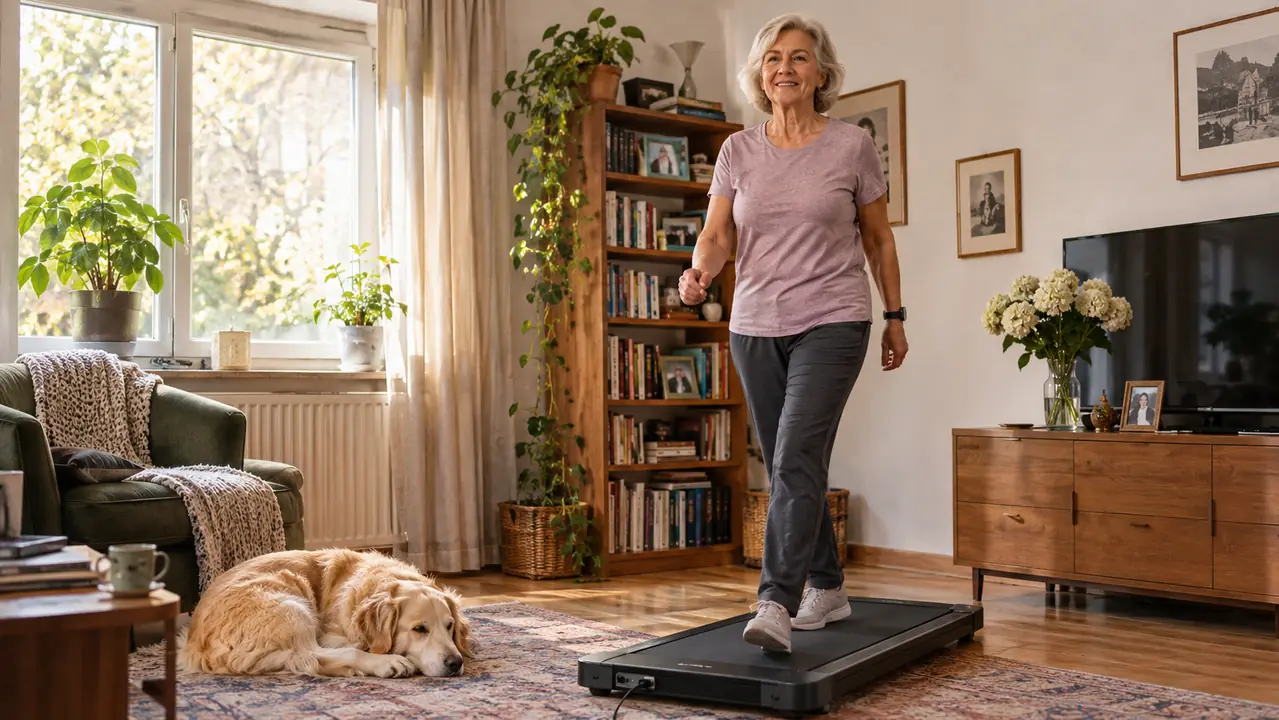
The box was heavier than I expected and I could not get it up the porch steps by myself, which is the first honest thing I can tell you about the UREVO walking pad. Dale hauled it inside. I cut the tape. Twenty minutes later I was walking at 1.8 miles an hour in my own living room while Mabel slept on the rug, and I understood why people buy these things.
I am 61, a retired school librarian in Asheville, North Carolina, and I started walking on purpose in my late fifties after my doctor had a blunt conversation with me about blood pressure. Mabel, our seven-year-old retriever-shepherd mix, is the reason walking became my actual exercise instead of something I kept meaning to get around to. She needs a long walk every single day. Some days the weather here does not cooperate, and some days my knees do not. The UREVO walking pad covers both of those days. After months of near-daily use, here is what I would tell a friend across the table.
The Quick Verdict
Quiet enough to keep in the living room, low enough to leave in place, and the incline is genuine work rather than a setting that exists on paper. It is heavy, there is no handrail, and the app is a nice extra rather than a reason to buy.
Amazon Check Today's Price →The walking pad I still step onto on the days Mabel and I stay home
It has lived in my living room for months, not in a closet. If weather or sore knees keep breaking your walking habit, this is where I would start.
Amazon Check Today's Price on Amazon →How I've Used It
My routine is dull and I am keeping it. Most mornings I walk Mabel first, come back, fill a glass of water, and get on the pad for twenty to thirty minutes while the coffee finishes. I set it between 1.8 and 2.5 miles per hour. That is not impressive and it is not supposed to be. Two years of steady walking has done more for me than any three-week burst I ever attempted, and the pad is what keeps the streak alive in February when the wind comes down off the mountain.
The pad shows speed and time on the LED display in front of you, and I write the number in a notebook that lives on the side table. That notebook is the whole system. I do not need a leaderboard, I need to know whether I walked on Tuesday. I also use it in the afternoons, ten or fifteen minutes after sitting too long at the quilting frame, which is a different kind of useful than a workout.
Dale uses it too, which I did not expect. He is not a walker by temperament. He gets on for ten minutes after lunch at 1.5 miles an hour and reads on his phone. The pad is quiet enough at those speeds that I can be sitting in the same room with a book and forget he is on it. In a small house, that is the difference between a machine you keep and a machine you resent.
The real test came in January, when we had four days of ice on the sidewalk and the temperature never got above freezing. Mabel got her walk on the cleared street, short and careful, and I got my twenty minutes inside afterward. In past winters that week would have been four days of nothing, and four days of nothing has a way of turning into three weeks. I wrote 1.9, then 2.0, then 2.1, then 1.8 in the notebook that week and did not miss a day. That is the entire case for owning one of these, and it took two winters for me to believe it.
What the Incline Actually Changes
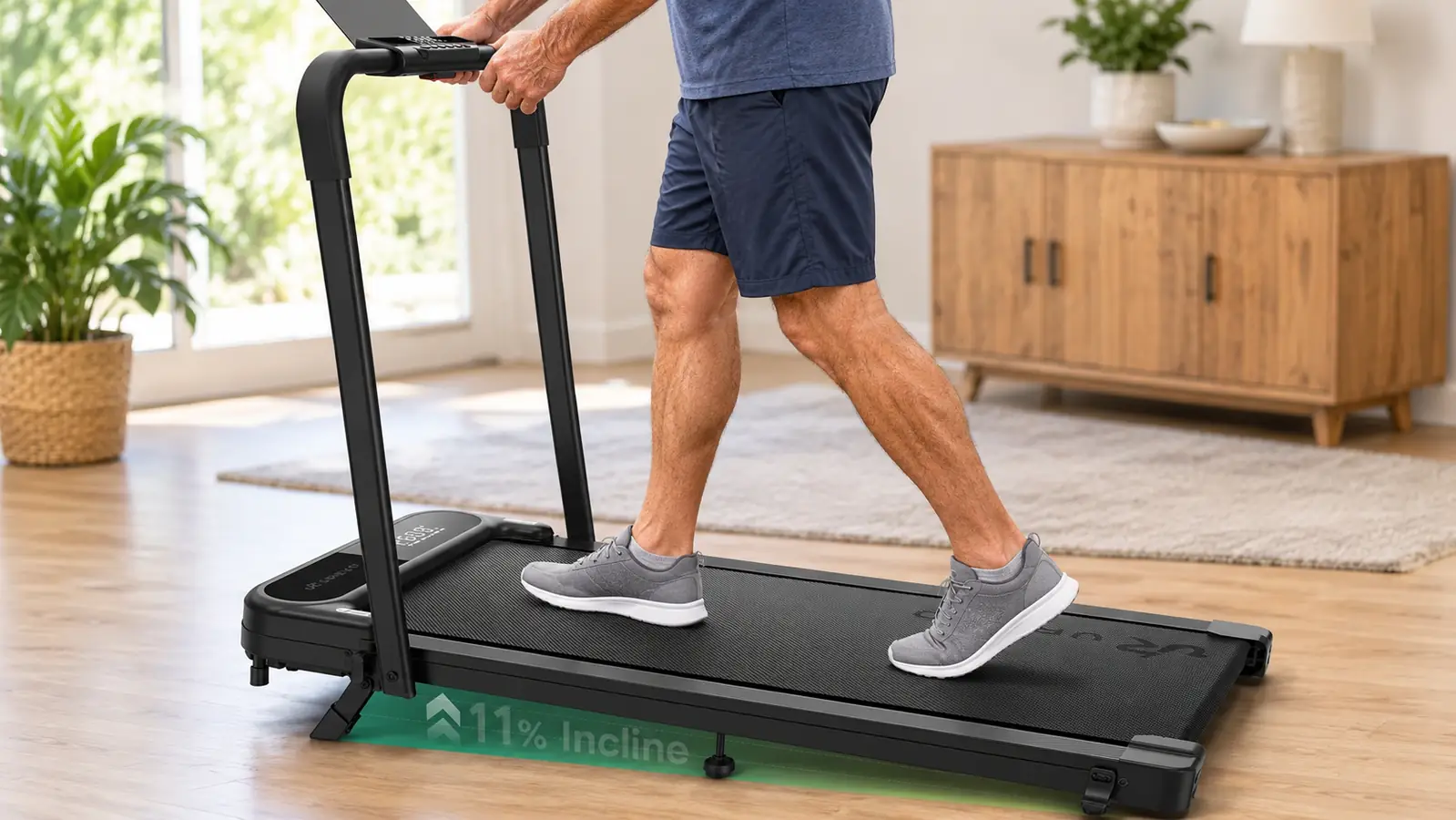
The UREVO has an 11% incline that you set manually, meaning you step off, adjust it, and step back on. I ignored it for the first month because flat walking felt like enough. Then I tried twenty minutes at 2.0 miles an hour with the incline up, and I understood what people are talking about. My calves were sore the next day in a way that flat walking at the same speed has never managed.
Here is the honest comparison. Twenty minutes on the incline feels harder than thirty minutes flat. That is genuinely useful when time is short, which it often is. It is also not a substitute for Mabel's walk, because she needs the sniffing and I need the daylight, and neither of those comes with a belt and a motor. Indoor walking is the backup plan. It is a good backup plan.
I keep the incline low most days and raise it once or twice a week. If you have knee or hip trouble, start flat and stay flat until you have several weeks of walking behind you. I am not a physical therapist and I will not pretend to be one. My knees told me what they thought of the higher setting, and I listened. Anyone with a health condition or on medication should talk to their doctor before adding incline work or anything else new.
Twenty minutes on the incline feels harder than thirty minutes flat. That is the whole argument for it, and after months of use it still holds up.
The Display, the App, and the Two Weeks I Spent Ignoring Both
The display is straightforward: speed, time, and the numbers you would expect, lit plainly enough to read at 6:40 in the morning without hunting for glasses. The pad connects over Bluetooth to the Urevo Fitness App, which offers routes and terrain settings, and the listing describes an auto-speed mode meant to follow your pace as you walk. I tried that mode twice. It works. I still went back to setting the speed myself, because I like knowing exactly what I am doing before I do it.
If the idea of walking a route somewhere else while you are standing in your living room appeals to you, the app is genuinely there for that and it is more than a step counter. If you are like me and simply want to walk, you can ignore it completely and the pad will not care. I would rather tell you that than oversell a feature you may never open. Plenty of reviews describe the app as the main event. For me it is a side dish.
I will say this much for it. In the first week I picked a route that climbed a hill somewhere I have never been, and the pad got harder under my feet in a way that matched the picture on the screen. That is not nothing, and I understand why people enjoy it. It also meant I spent the walk looking at a screen instead of out the window at the bare trees, and by the end of that week I had decided I preferred the window. If you need something to look at besides your own living room, the app solves a problem I do not have.
Living With It in a Small House
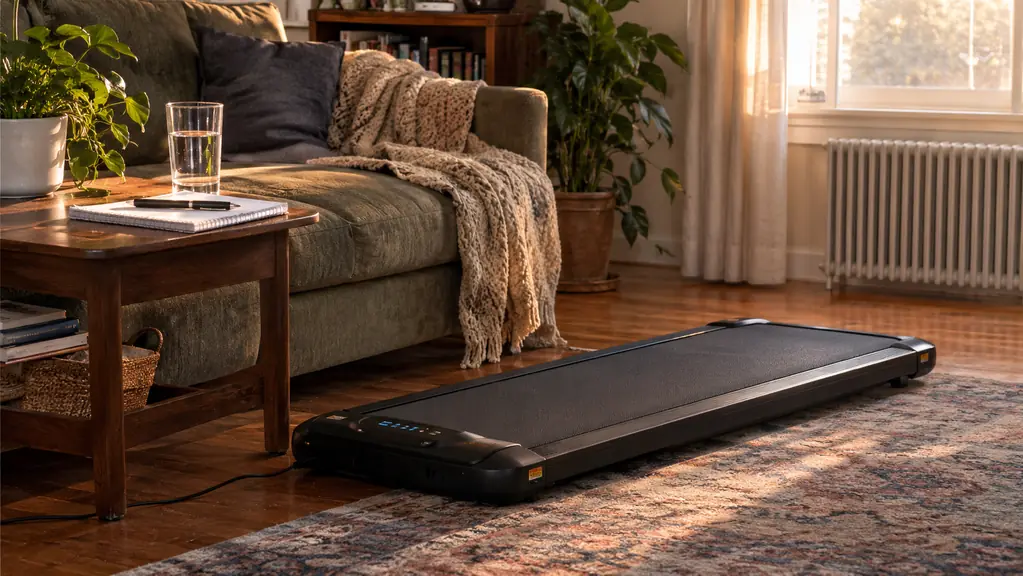
Our house is a two-bedroom with a kitchen that fits one person comfortably and a hallway where the scale lives. The pad is 45 inches long, 22 inches wide, and just under 4 inches tall, so it sits against the living room wall without swallowing the room. It weighs 43 pounds. I can drag it a few feet across the rug when I want the space back. I would not carry it up a flight of stairs, and I would not want to move it twice a day.
That weight is the tradeoff for how planted it feels. I have walked on a lighter pad at a friend's house that crept under me at 2.5 miles an hour, and I spent the whole time thinking about my footing instead of my walking. This one does not move. The maximum weight recommendation is 265 pounds, and the motor is listed at 2.25 horsepower with a top speed of 6.2 miles per hour and a low end of 0.6. I have never taken it past 3.5. At 45 inches long, a long stride at high speed was never the point of this machine.
Before it arrived I measured the gap between the sofa and the bookshelf with a tape measure, because I have bought furniture that did not fit and I was not doing it again. Twenty two inches fit with room to spare. Under four inches of height meant I could step over it to cross the room, which sounds trivial until you have lived with a machine you have to walk around instead. It sits on the rug without marking it. I have not once stubbed a toe on it in months of use, which is more than I can say for the coffee table.
What Months of Steady Use Felt Like
The first two weeks were awkward. I looked down at my feet constantly, which is exactly the wrong thing to do, and I kept reaching for a handrail that is not there. By the third week I had stopped thinking about the belt and started thinking about whatever I was reading. That is when a piece of equipment stops being a novelty and becomes part of the furniture, and it is the only test I really trust anymore.
What changed for me was not dramatic and I am not going to dress it up. I walked more days than I would have without it, particularly in winter and on the days my knees were complaining. More walking days, stacked up over months, is the entire mechanism. Results vary from person to person, and if you are looking for a machine that produces a number on a scale by a certain date, this is not that and neither is anything else I have tried.
There is a stretch in October I remember because it was completely ordinary. I walked on the pad five mornings out of seven, all of them between 1.9 and 2.4 miles per hour, and I could not tell you anything remarkable about a single one of them. That is what I actually want from a machine like this. Not a story. A Tuesday where the walking happened anyway because staying in the chair was the only alternative on offer.
Where It Falls Short
There is no handrail. If balance is a concern for you, that is a real consideration and not a small one. I steady myself on the back of a chair for the first thirty seconds and then I am fine, but I have been walking daily for two years. Someone coming off a long stretch of inactivity should talk to their doctor first and should have something solid within arm's reach for the first few weeks. That is not a knock on this pad specifically. Almost every pad in this category is built the same way.
The pad is also not silent at higher speeds. At 3 miles an hour and above, the motor is audible from the next room, and the belt makes a steady whirring sound that took me a few days to tune out. At the 1.8 to 2.5 range where I spend most of my time, Dale can watch a basketball game in the same room without turning the volume up. And changing the incline means stopping, which breaks the rhythm if you are mid-session.
What I Liked
- Quiet at walking speeds, so it can live in a shared room
- The 11% incline is real resistance when you only have twenty minutes
- Just under 4 inches tall and 22 inches wide, so it stays in place in a small house
- Feels planted underfoot at 2 to 3 miles per hour, no creeping
- Works perfectly well with the app switched off
Where It Falls Short
- 43 pounds, and moving it daily would get old fast
- No handrail, which matters if balance is a concern
- Motor is audible above roughly 3 miles per hour
- Incline is manual, so you stop walking to change it
- App routes are a bonus, not a reason to buy
Who This Is For
This is for someone who already walks and wants to protect the habit from weather, dark evenings, and sore joints. It is also for the person who works from home and wants ten minutes of movement between calls without changing clothes or leaving the house. My rule applies: if you would not walk outside for twenty minutes, a pad will not turn you into a walker. But if you already would, and something keeps getting in the way, this removes the excuse.
It suits a small house, a shared living room, and a person who wants a plain machine that does one thing without asking for attention. It suits someone who will use the incline once or twice a week and walk flat the rest of the time, which is most of us. And it suits a household where two people will use it, because a pad that only one person touches tends to end up against the wall permanently.
Who Should Skip It
Skip it if you need to hold on to something while you walk. Skip it if the plan is to store it in a closet and haul it out each time, because 43 pounds gets heavier by the third week. Skip it if you want to run. A top speed of 6.2 miles per hour on a 45-inch deck makes this a walking machine, and treating it as anything else will disappoint you.
And skip it if the only reason you are considering it is that you feel guilty about something. Guilt does not walk. It buys equipment and then it puts the equipment against the wall. I have done that with a stationary bike and I am not proud of it. Talk to your doctor before you start changing your exercise, especially if you have a health condition or take medication, and then start slower than you think you should.
If you already walk, this is how you keep walking in February
Start flatter and slower than feels impressive. Write it in a notebook. The pad will still be in the corner in March, and so, most likely, will you.
Amazon Check Today's Price on Amazon →