
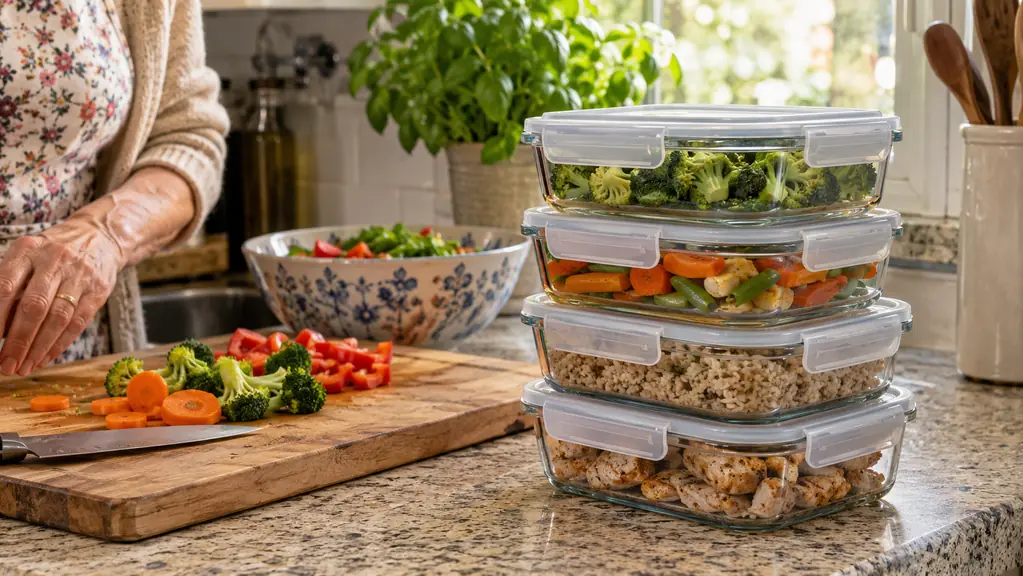
This is not a review that opens with me adoring a container. I bought the Rubbermaid Brilliance Glass Food Storage Containers for a boring reason. My kitchen had become a place where I guessed at portions, and guessing is how I got myself into trouble in my late fifties. I am sixty one now, retired from a school library in Asheville, and the change that actually stuck for me was never a diet. It was measuring. To measure, you need something to measure into, and the flimsy plastic I had been reusing for two decades was not going to do it. So I ordered these. Four glass bases, four lids, 3.2 cups each. Six months later I have opinions, and a few of them are not flattering.
Here is what nobody tells you about glass containers. The container is the easy part. Any glass rectangle will hold food. What decides whether you reach for it at six in the morning or shove it aside looking for a plastic tub is the lid. That is where Rubbermaid earned my money and also where these cost you a little patience. I want to walk through both, because the product photos make the whole set look frictionless and it is not frictionless. It is good. Good and frictionless are not the same thing.
The Quick Verdict
The lids genuinely seal and the glass moves from refrigerator to microwave to oven without drama. It is noticeably heavier than plastic and the 3.2 cup size runs small for a full meal, so buy knowing what you are actually getting.
Amazon Check Today's Price →The lid is what you are paying for. See the current price on the four count set.
Four glass bases, four airtight lids, dishwasher safe, oven safe to 450 degrees. Check today's price and the size options before you commit.
Amazon Check Today's Price on Amazon →What the Listing Does Not Tell You
Three and a fifth cups sounds generous until you fill one up. For some people that is a solid lunch. For me, building a plate around a protein, a vegetable and a starch, it lands closer to a side dish plus a snack. I now use two of them for a single dinner, one for the meat and one for the vegetables, which means the four count set does not cover four days of lunches the way I assumed it would. That is not a flaw in the container. It is the gap between what a number on a page means and what it looks like sitting on a counter. The Rubbermaid bases come in larger sizes in the same line, and because the lids are universal across all Brilliance containers regardless of material, a mixed set still stays organized in one drawer.
The second thing nobody says out loud is weight. The set is 6.9 pounds before you put a single thing in it. Carrying four loaded glass containers in a tote bag out to the car, then across a parking lot, is a different experience from carrying plastic. If you pack a lunch for a job where you park three blocks from the door, this matters more than any bullet point admits. I have a shoulder that complains and I notice it. For home use, which is mostly what I do, weight is irrelevant. For commuting, it is the whole conversation.
Third, the rectangular form. They stack beautifully and waste almost no shelf space in my refrigerator, which is honestly the reason I have kept them. But a rectangle inside a round lunch bag, next to a round thermos and a round apple, is a small daily annoyance. I switched to a square tote and the problem disappeared. That is a small fix, not a reason to avoid the product, but it is the kind of thing you only learn after you have already packed the bag.
How I Actually Use Them in a Week
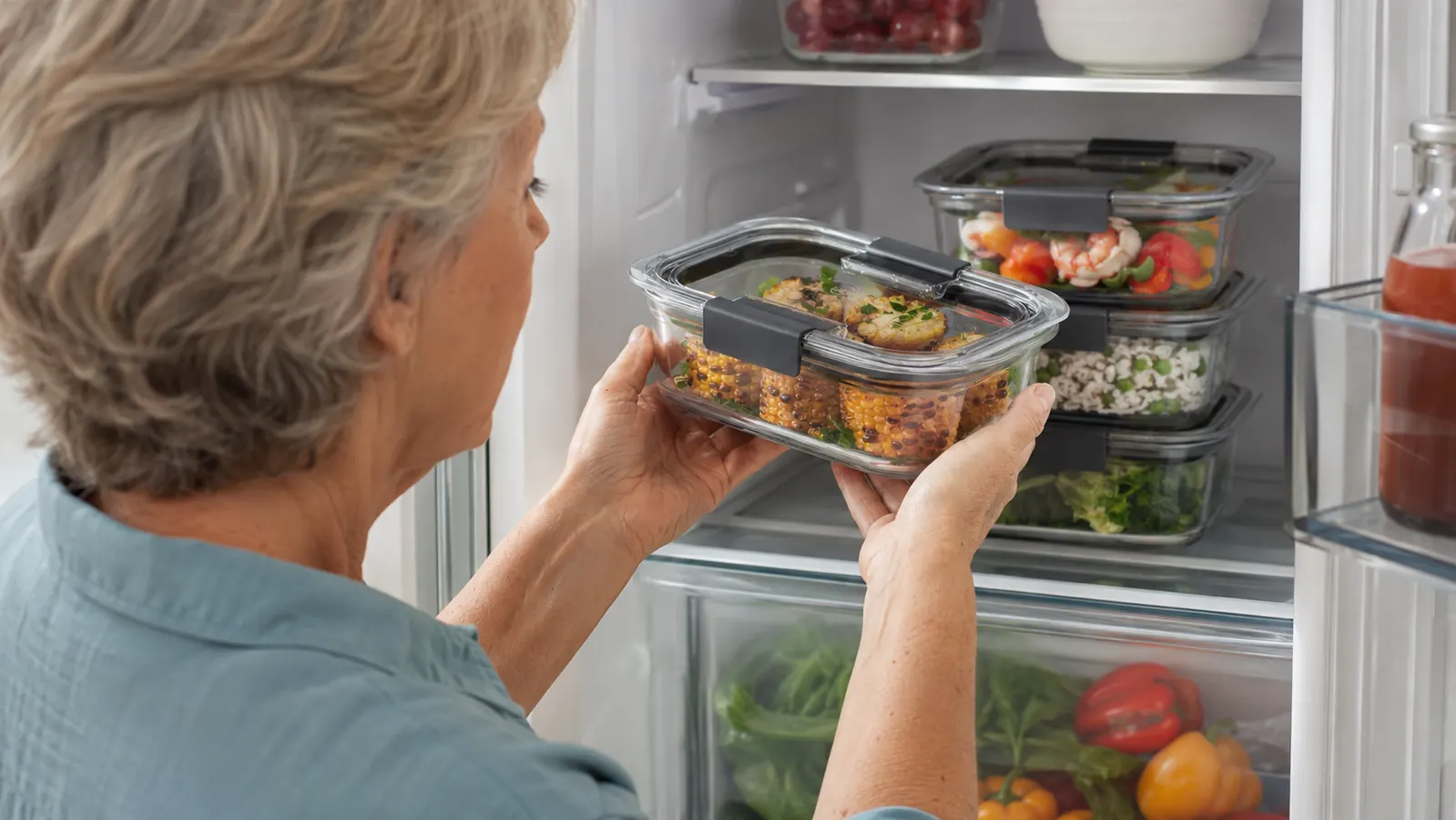
Monday morning I cook more than I need. Not a formal meal prep session with matching containers lined up like a magazine spread. I just make extra, usually a tray of chicken thighs and a sheet pan of whatever vegetables were on sale, and while the food is still warm I portion it out and press the lids down. The containers go straight into the refrigerator. Over the next three days I pull one out, take the lid off, and reheat the food right in the glass base in the microwave. The vented lid means I do not have to hunt for a paper towel to guard against splatter. I set the lid back on loosely with the vent open and that is that. Not having to think about it is exactly why these stayed on the counter and the old plastic went into the donation box.
I also use them for things that are not leftovers. Cutting a whole watermelon used to mean half of it sliding around on a plate under foil. Now it goes into a container, lid on, and it stays put. Same with a bag of grapes rinsed on Sunday afternoon. Same with the half onion that otherwise perfumes the entire refrigerator. That last one is where the odor resistant claim earns its keep. I have opened a container of leftover salmon four days later, then opened a container of strawberries, and the strawberries did not taste like salmon. That is not nothing in a small kitchen with one shelf worth using.
The glass bases also double as cookware, which I did not expect to use and now use weekly. The listing says the bases are oven safe up to 450 degrees. I have put them in at 400 for a single chicken breast and a serving of roasted broccoli, no lid of course. What that means practically is one less pan to scrub and one less transfer from pan to storage. I am sixty one years old and I will trade away a pan for almost anything.
There is one more habit worth mentioning. Dale takes a container to the church kitchen on Tuesdays, where he and three other men cook for the Wednesday night crowd. He has dropped his twice on the concrete steps, and both times it came back with the food still inside and the lid still latched. That is not a scientific durability test. It is just what happened, twice, and it is why I stopped worrying about the glass.
I opened a container of leftover salmon four days later, then opened a container of strawberries, and the strawberries did not taste like salmon.
The Lid Is the Whole Story
The lids are airtight and leak proof, and I tested it the foolish way. I filled one with soup, latched it, and turned it upside down over the sink for a count of thirty. Nothing came out. I have since carried soup in a tote bag laid flat on the car seat and arrived with the soup still in the container and not on my upholstery. That is the standard I care about, and these meet it.
The latches are the part worth looking at closely. There are tabs on the long sides and they snap with a firm click you can hear from the next room. Firm is good for sealing. Firm is less good at six in the morning before coffee. I learned to press both tabs down at once rather than one at a time, and that one change turned a fiddly lid into an easy one. The lids also carry a gasket sitting in a channel around the rim, and that gasket is where all the real maintenance lives. Food gets under it. If a lid comes out of the dishwasher holding water in that channel, you will find a thin film of damp the next time you reach for it. I shake the Rubbermaid lids out, stand them on edge to dry, and the problem mostly goes away. If you are the sort of person who pulls a lid straight off the dishwasher rack and snaps it onto food, you will be annoyed by this. That is honest, and it is not a dealbreaker, but the short reviews never mention it.
The lids are also the reason I stopped losing containers. Universal lids fit across all Brilliance containers regardless of material, so when I eventually added a larger piece, the lid from a smaller base still worked on it. For a household with a drawer full of orphaned lids that fit nothing, that is a genuine fix and not a marketing line.
How They Have Held Up After Six Months
Six months of daily use, and the most useful thing I can report is what did not happen. No chipped rims. No cracked base. No lid that quit latching. I did drop one on the tile floor from counter height and it survived, which I do not recommend testing and do not plan to repeat.
The glass has stayed as clear as the day I unboxed it. That sounds trivial until you remember what a plastic container looks like after one winter of chili. Everything here is dishwasher safe and I have run all eight pieces through hundreds of cycles without clouding or warping. The stain resistant claim holds up in the practical sense. Tomato sauce sat in one for four days and left no orange ring behind.
Stacking is the feature I underestimated most. The bases are modular and the lids sit flat, so four containers take up a footprint roughly the size of a sheet pan on my refrigerator shelf. In a small two bedroom house with a modest kitchen, that is the difference between a shelf I can use and a shelf I avoid because reaching into it means an avalanche.
Where They Fall Short
They are not inexpensive, and I will not pretend the value argument is obvious. Per container, glass with a latching lid costs more than a plastic tub. What I would say in return is that I replaced plastic containers roughly every eighteen months for twenty years because they stained, warped, or lost a lid. I have not replaced any of these yet.
A more specific complaint. The 3.2 cup size is an awkward middle. It is too big for a dab of sauce and too small for a full dinner for a grown adult, so four of them do not amount to a complete set for a household cooking for two. I ended up ordering more. That is worth knowing before you click buy, because four count reads like a full set and it is really a starter set.
And there is the splatter point. The vented lid is splatter resistant, not splatter proof. If you reheat something with any fat in it on high for three minutes with the vent closed, you will be wiping the inside of your microwave. Open the vent. That is the entire instruction, and I ignored it twice before it sank in.
One more small thing. The set arrives as four bases and four lids and nothing else, no sleeve and no carrier, and the box is the sort of packaging you will want to break down the same afternoon. That is not a complaint about the product. It is a note for anyone who assumes a set shows up ready to travel.
What I Liked
- Lids are genuinely airtight and leak proof, tested upside down with soup
- Glass bases go from refrigerator to microwave to oven up to 450 degrees
- Vented lids cut down on splatter without a paper towel
- Universal lids fit across the Brilliance line, so nothing gets orphaned
- Dishwasher safe and stayed clear after six months of heavy use
- Modular bases stack flat and take up very little shelf space
Where It Falls Short
- 3.2 cup capacity is small for a full adult meal, so four is a starter set not a complete one
- The set weighs 6.9 pounds empty, which matters if you carry lunch any distance
- The lid gasket traps water in the dishwasher and needs to be dried on edge
- Latches are firm and take two hands until you learn to press both tabs at once
- Costs more per container than plastic, and the savings take years to show up
The Measuring Part, Which Is the Actual Point
I should be clear that containers did not do anything for me on their own. What they did was remove an excuse. When I cook, I portion into a fixed volume instead of eyeballing a scoop and calling it a serving. Two of these containers is a known amount. A plastic tub the size of my hand is a guess. Over a couple of years of small decisions, the difference between a known amount and a guess added up to something, and it added up quietly, without any of the drama I had been promised by every book I read in my fifties.
The other half of my routine has nothing to do with the kitchen. Mabel, our retriever mix, needs a long walk every day whether I feel like it or not, and that walk became my main exercise. She is seven and around seventy pounds and she does not accept excuses. Dale and I take her out in the morning and I take her again after supper. The scale lives in the hallway, I step on it once a week, and I write the number down. That is the whole system. Containers in the kitchen, a dog who insists on walking, and a pencil.
If you are changing how you eat because of blood pressure, cholesterol, blood sugar, or anything else a doctor has flagged, please talk to that doctor before you change anything, especially if you take medication. I am a retired librarian with a kitchen, not a clinician. What worked in my house is not a prescription for yours, and results vary for everyone. I say that plainly because too much of what I read in my fifties skipped past it.
Who This Is For
This set makes sense for someone who already cooks at home and wants to stop guessing at portions. It suits anyone who reheats in glass rather than plastic, anyone who has a small refrigerator and needs containers that stack flat, and anyone tired of buying plastic every year and a half. It is also a good fit if you own a scale and use it, because a fixed volume container and a scale argue with each other less than a scoop and a scale do. And it is a reasonable buy if you want one vessel that goes from the oven to the refrigerator to the microwave without a transfer in between. The Rubbermaid line also sells single pieces, so you can start with the four count and add as you learn which size you actually reach for.
Who Should Skip It
Skip these if you need to carry lunch a long way. The weight is real and it does not get lighter. Skip them if a full dinner for an adult needs to fit in one container, because 3.2 cups will not do it and you will be ordering a second set within a month. Skip them if you know in your heart that a wet lid coming out of the dishwasher is going to end up on a container rather than on a drying rack, because the gasket will sour on you and you will blame the product.
And skip them if you want the cheapest option on the shelf. These are not that, and pretending otherwise would waste your time. What they are is the set I stopped thinking about six months ago, which for a kitchen tool is about the highest compliment I know how to give.
Six months in, four of these are still on my counter and the plastic is gone.
Airtight lids, oven safe glass to 450 degrees, dishwasher safe, and lids that fit the whole Brilliance line. Check today's price and the larger sizes before you decide.
Amazon See Current Price and Sizes on Amazon →