
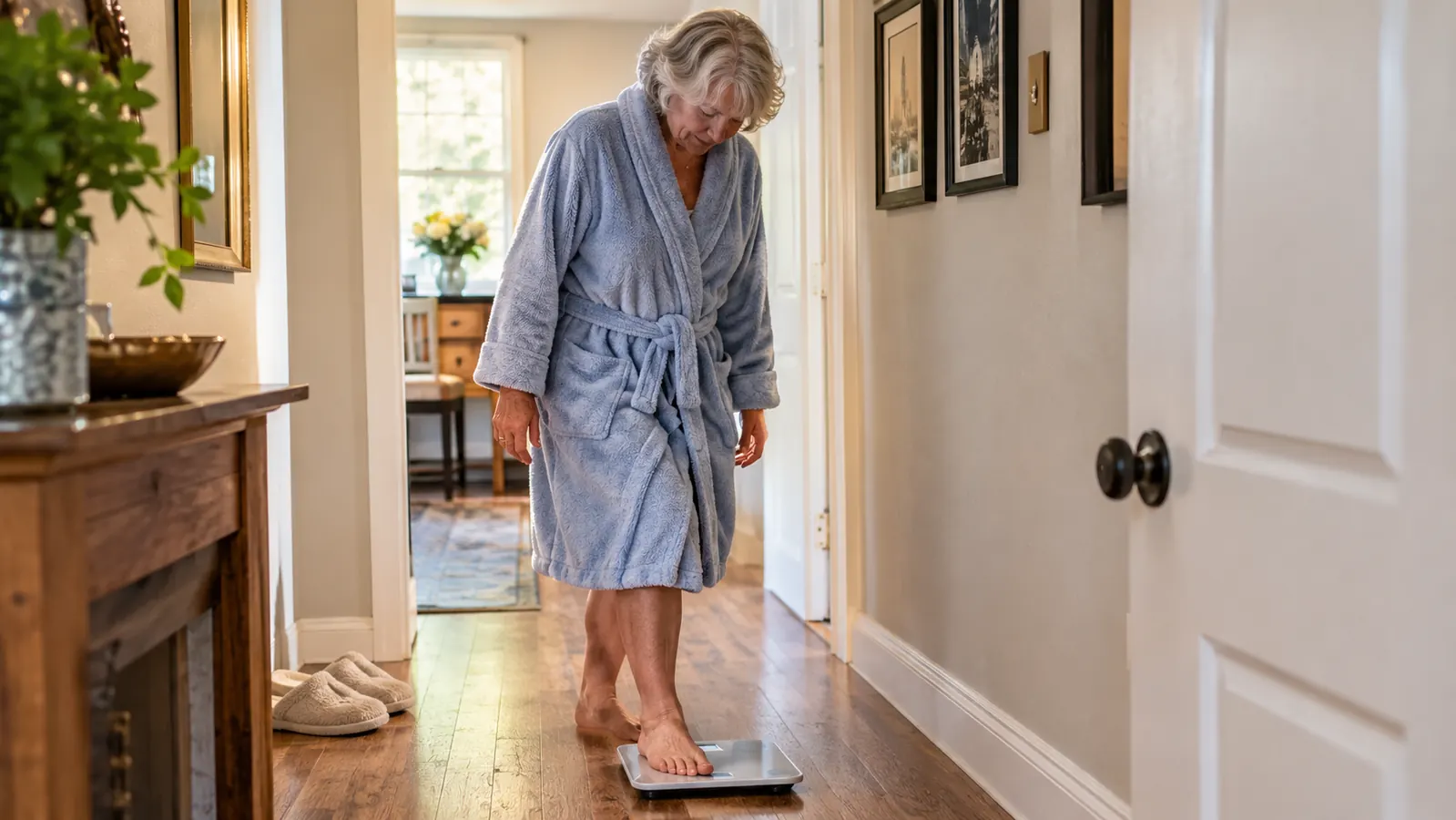
The number on the scale is the reason most people stop stepping on it. You weigh Monday and you are down a pound. Tuesday you are up two. By Thursday you have decided the whole business is broken, and you push the scale under the bed with your foot and go make toast. I did exactly that for years, and I was not wrong about the daily number being noise. I was wrong about what to do with the noise.
What I needed was a trend, not a verdict. That distinction is the entire point of this article, and it is why there is a RENPHO smart scale in my hallway now instead of the flat bathroom scale I used from the nineties until my late fifties. The RENPHO does the bookkeeping. It records what I weigh and shows me a line running across weeks instead of one number on one Tuesday, and it keeps that record whether or not I feel like looking at it. The rest of this is what I actually do with that line, step by step, in a two-bedroom house in Asheville with a husband, a dog, and very little patience for an app that scolds me.
The line matters. The number on any one morning does not.
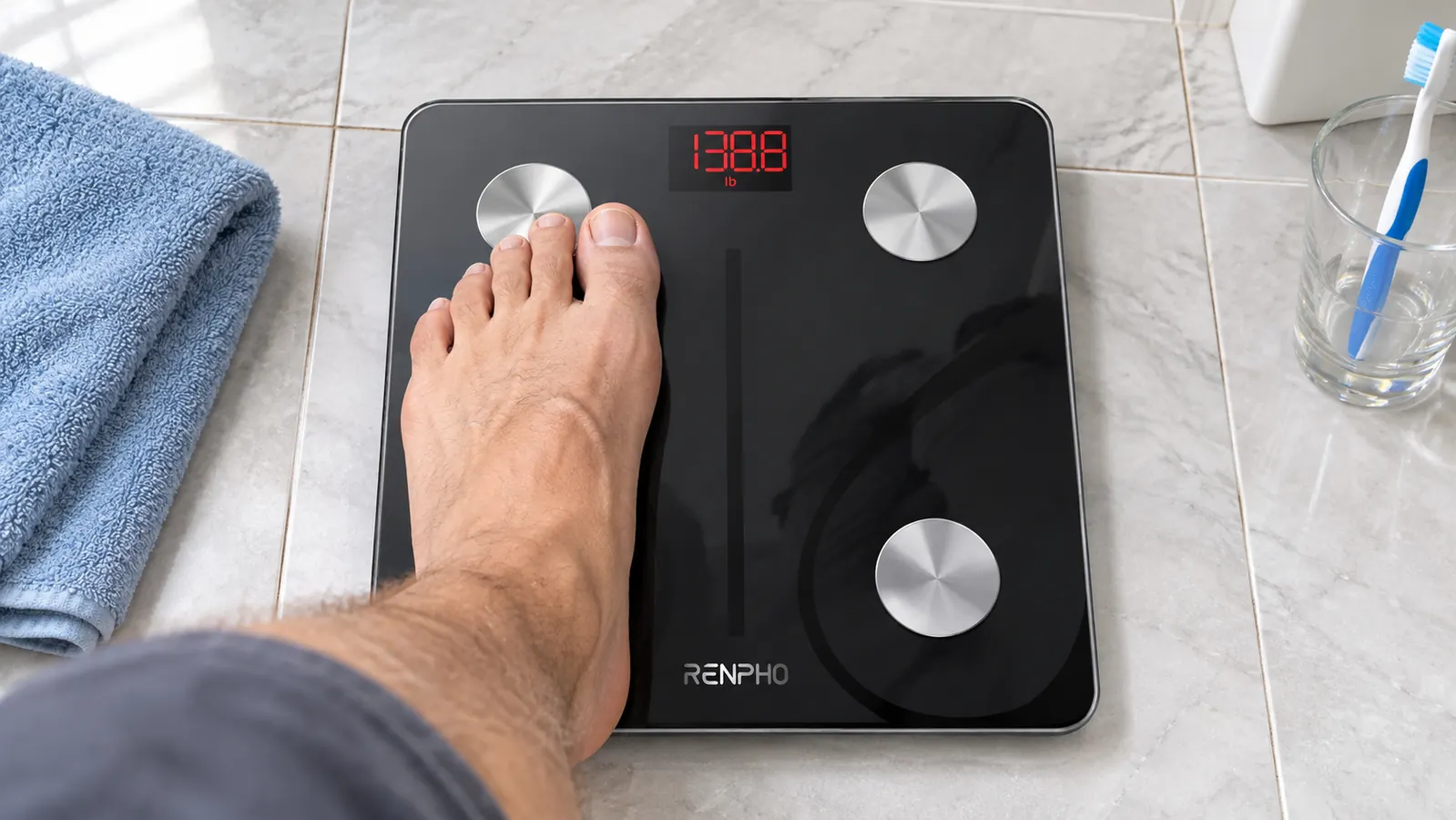
The RENPHO Elis 1 records weight, BMI and body fat and keeps 13 metrics in the RENPHO Health app, syncing over Bluetooth so the record builds itself while you get on with your coffee.
Amazon Check Today's Price on Amazon →Step 1: Give the scale one spot and stop moving it
My scale lives in the hallway outside the bathroom door, on the hard floor, about a foot from the wall. It has been there for two years. That is not tidiness, it is method. A scale reads the floor underneath it. Carpet, a bath mat, a grout line, a slight tilt, all of it changes the answer. Weigh on the rug Monday and the tile Friday and you have not measured your body. You have measured your flooring, and then you have blamed yourself for the difference.
So pick a hard, flat spot you already walk past every morning. Not under the sink where you have to drag it out. Not in the closet behind the vacuum, because anything you have to retrieve is anything you will quit. Somewhere your bare feet land before you are properly awake. Mine is the hallway, and Mabel has learned to step around it, which took about a week and one bumped nose.
Keep it out of the wet part of the bathroom if you can manage it. A damp floor and a scale are not good company, and a scale that gets kicked against the baseboard every morning is a scale that gives you a different answer every time you ask. The first winter I owned it I slid it onto the bath mat for two weeks because the tile was cold on bare feet, and my readings for those two weeks ran high and bounced around like a cork. Nothing about me had changed except the floor. I moved it back and the numbers settled. One spot, one surface, one small rectangle of floor that belongs to the scale and to nothing else. That is the whole step.
Step 2: Weigh at the same time, under the same conditions
I weigh first thing, after the bathroom, before coffee, before my glasses go on. Same routine, same floor, same state of undress. That sounds fussy until you think about what the scale is actually doing. What you eat and drink has weight, and the scale cannot tell the difference between a pound of water and a pound of anything else. Change the conditions and you are comparing two different measurements and calling the difference progress.
This scale reads in steps of 0.05 kg, which is fine enough to notice a glass of water. That sensitivity is exactly why one reading is worthless and a series of readings is useful. It is also why I do not weigh after a salty dinner, and why I skip the morning after a long July walk with Mabel, because I will be carrying less water than usual and the number will flatter me for all the wrong reasons.
One weigh-in a day is enough. Two is not twice as accurate, it is twice as confusing, and it hands you a reason to pick whichever number you prefer. Step on once, look, get off, go make coffee. The first week is just a baseline anyway. You are not trying to hit anything yet, you are trying to find out where you actually are on an ordinary Tuesday. My own first seven mornings produced numbers spread across nearly two pounds, and not one of them meant anything except that I am a person who drinks a great deal of coffee and had a salty supper that Wednesday. I wrote all seven down, drew no conclusions, and waited for the eighth.
Step 3: Let something else do the recording
The RENPHO Health app is the part that changed my mind about smart scales. You pair it with the scale over Bluetooth and after that you step on and walk away. The reading goes into the app and stays there. Weight, BMI and body fat show on the scale itself, and the app keeps the longer list of 13 metrics, including a few I do not pretend to fully understand.
I still keep a paper notebook. That is not redundancy for its own sake. I am sixty-one and I like a page I can flip back through with a cup of coffee, and writing a number down makes me look at it in a way that scrolling never does. But the notebook has become the commentary rather than the record. Before, if I forgot to write it down, the morning was gone. Now the app is the spine of the thing and the notebook is the margin.
The scale runs on two AAA batteries and shuts itself off when you step away. The display is backlit, which I notice most at six in the morning in a hallway with one lamp on. The whole thing weighs a little over a kilogram, so it is easy to pick up. Picking it up is the one thing I would tell you not to do.

Step 4: Read the line, not the dot
Here is the habit the whole thing hangs on. When you open the app, do not look at this morning's number. Look at the shape of the last four to six weeks. Compare this Tuesday to last Tuesday, not to yesterday. If the line is drifting in the direction you expected over a month, the system is working, even if this particular morning was ugly.
The body fat reading is the one I check least and trust most loosely. It shifts with hydration, and it is a direction rather than a diagnosis. I look at it once a month next to the weight line, the way you would glance at a forecast you already know is approximate. If it moves a point and then moves back, that is not news. If it moves and stays moved for a month, that is worth a mention at your next appointment.
Plateaus are where people quit, and they are also where the line earns its keep. A flat stretch of three weeks looks like failure on a single morning and looks like a pause on a chart. That pause is information. It might be a stretch of poor sleep, a new medication, a colder month with shorter walks, or simply the body doing what bodies do. Write down what else was happening that month. I had one stretch in February that ran nineteen days without moving in either direction, and when I went back through the notebook the cause was sitting right there in my own handwriting: Dale's birthday, two dinners out, and a run of four-hour nights because of a quilting deadline I set for myself and then complained about. The line was flat. The month was not. In a year you will have a record of causes, not just numbers.
If your app draws the line for you, use it. If you are a notebook person like me, average each week on Sunday night and write the average in the margin. Four numbers a month is a trend. Thirty numbers a month is a mood swing with a decimal point.
Step 5: Review it once a month and take it to your doctor
Once a month, on the first Sunday, I sit at the kitchen table with the notebook and the phone and look at four weeks side by side. Not to judge, to notice. I ask two questions. Is the line going where I expected it to go, and is anything in my life changing the shape of it, a trip, an illness, a stretch of bad sleep, a week when Dale was in charge of dinner.
The other thing I do is bring the trend to appointments. My doctor flagged my blood pressure in my late fifties and that is what started all of this in the first place. Having a record of weeks rather than a memory of one number is more useful to her than anything I could reconstruct in the parking lot. She can see what a medication change did over a month, or did not do.
I am not going to tell you what your line should look like and I am not going to tell you what to change. Talk to your doctor before you change your diet or your exercise, especially if you take medication for blood pressure, blood sugar, or anything else that affects weight and water. That conversation is worth more than every article on the internet, this one included.
What Else Helps
Walking did the most for me, and I did not choose it for the exercise. I chose it because Mabel is seventy pounds of retriever and shepherd and needs a long walk every single day whether I feel like it or not. Our loop is a little over two miles, down to the end of the street, around the block with the fence the boxer lives behind, and back up the hill that Mabel takes at a trot and I take as a negotiation. In bad weather we cut it to the short version and I count it anyway. Somewhere in the first year that obligation turned into the part of the day I look forward to. The scale measures the result. The dog is the reason there is a result to measure.
A tape measure helps too, and so does one pair of jeans that does not lie. Weight moves for reasons that have nothing to do with fat, and a waist measurement taken on the same morning every two weeks fills in something the scale cannot see. So does a kitchen where the easy choice is the available one, which for me meant moving the crackers off the counter and putting the cutting board where the crackers used to be.
And know when to skip it. A week of travel, a stomach bug, a bad night, all of those weeks get a pass. I do not weigh during them and I do not open the app afterward to feel bad about a number that was never a fair measurement to begin with. A smart scale is a mirror with a memory. It is not a plan, and it is not your conscience. It is a clerk, and a good clerk just writes things down.
The scale is not keeping score. It is keeping a record. Those are different jobs, and only one of them is useful.
Tomorrow morning is the first dot on the line
Put the RENPHO Elis 1 in one spot, step on once a morning, and let the RENPHO Health app hold the record while you get on with your day. Current price is on the product page, and the batteries come in the box.
Amazon Check Today's Price on Amazon →