
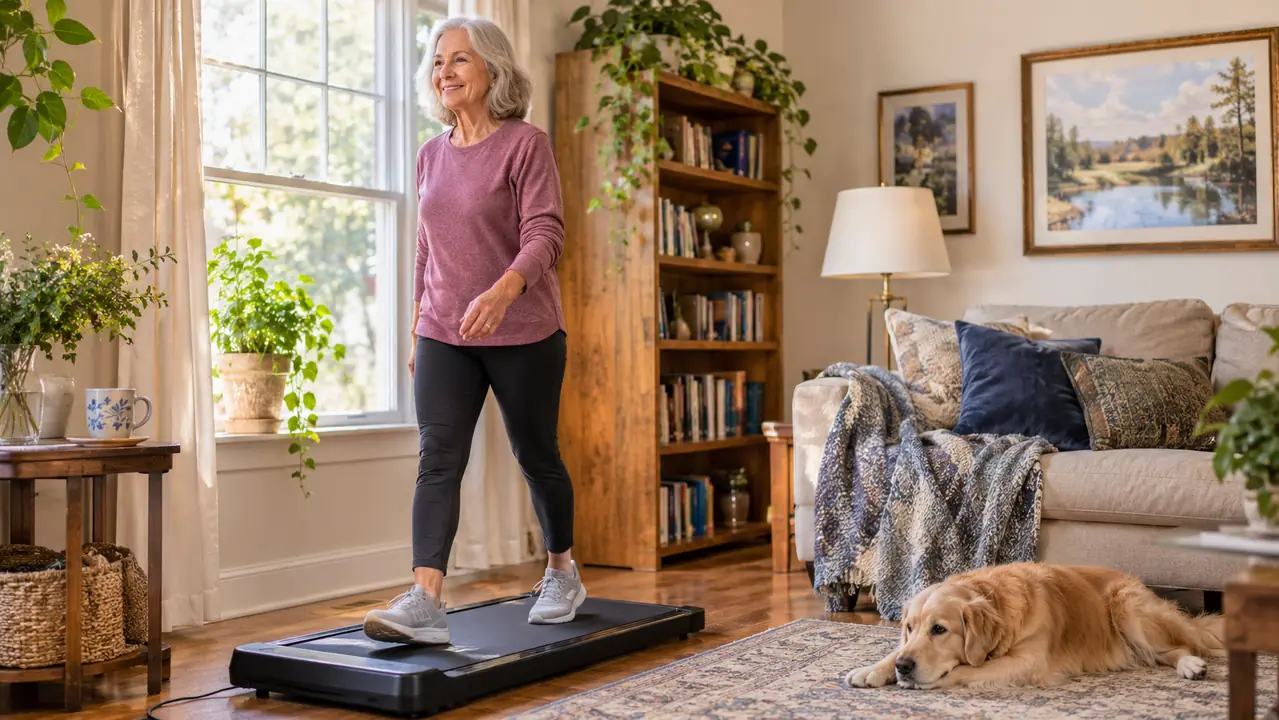
I did not set out to become a woman who walks in her own hallway. I set out to keep Mabel walked, keep my blood pressure out of my doctor's red pen, and keep my knees from stiffening up after an hour at the quilting frame. The hallway was not part of the plan. Then February in Asheville did what February does, and I went nine days without a real walk. Nine days is long enough to lose a habit you thought you had.
So this is not really an article about equipment. Most people who buy a walking pad use it hard for two weeks and then start hanging things on it. Not because the machine failed, but because nobody told them how to build the habit around it. I have had a UREVO Smart 11% Incline Treadmill in my living room long enough to know what stuck and what did not, and almost none of it was about the machine. It was five boring decisions I made in the first month. Here they are, in the order I made them.
The pad that made winter walking possible in this house
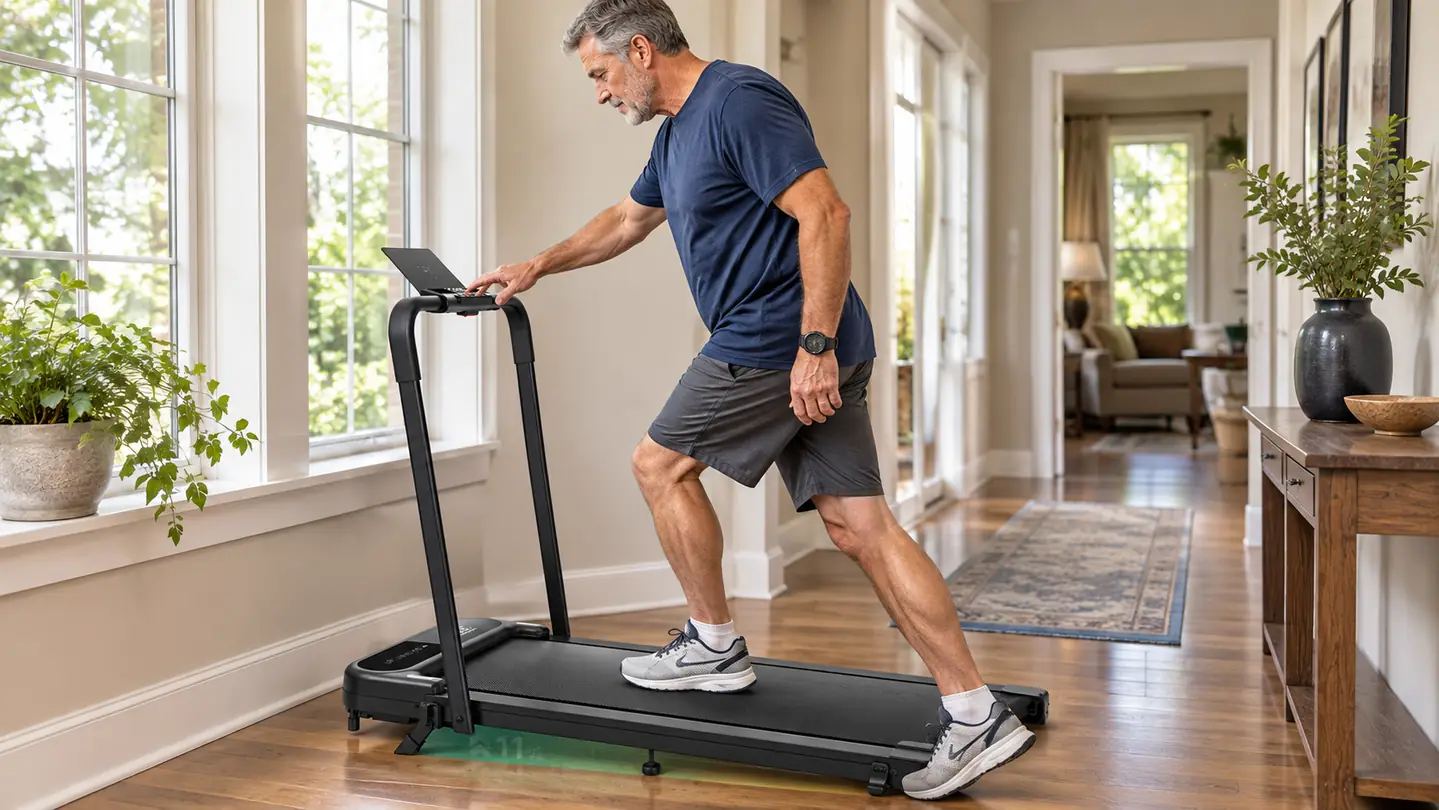
The UREVO Smart is the thing humming at the end of my living room right now. Manual incline up to 11%, a top speed of 6.2 mph, Bluetooth to the UREVO app, and a footprint of 45 by 22 inches that fits a hallway. It is not a gym treadmill and it is not pretending to be one.
Amazon Check Today's Price on Amazon →Step 1: Pick the time before you pick the machine
My walking time is 7:40 in the morning. Not because mornings are magic, but because I sat down with a pencil and found the one slot in my day when nothing else wanted me. Mabel has had her walk, Dale has left, and the coffee has not yet turned into the second cup I sip while reading. That slot existed before the walking pad did. I had just never claimed it. The first version of this plan, back in January, was 'after lunch.' I want to be honest about how that went. After lunch is when the mail comes, when Dale wants to know what is for supper, and when the phone rings. I moved the walk to after lunch eleven times that month and actually did it four. Pick your slot by what survives an ordinary Tuesday, not by what sounds virtuous on a Sunday night.
Most people do this backwards. They buy the machine, then go looking for a time to use it, and the only open slots left are the ones already crowded with things they avoid. So the pad waits by the wall and gets quieter every week. If you want a daily habit, name the time first, and name a time you would defend if a neighbor called and asked you to do something else.
I wrote mine on the paper calendar in the kitchen, the same place the dentist and the quilting guild meeting go. I also decided in advance what happens when I miss, because I was going to miss. The rule is: walk the next morning and do not make up the missed minutes. Two days skipped in a row is where habits go to die. One day is just a day.
Step 2: Give it a permanent spot and measure that spot first
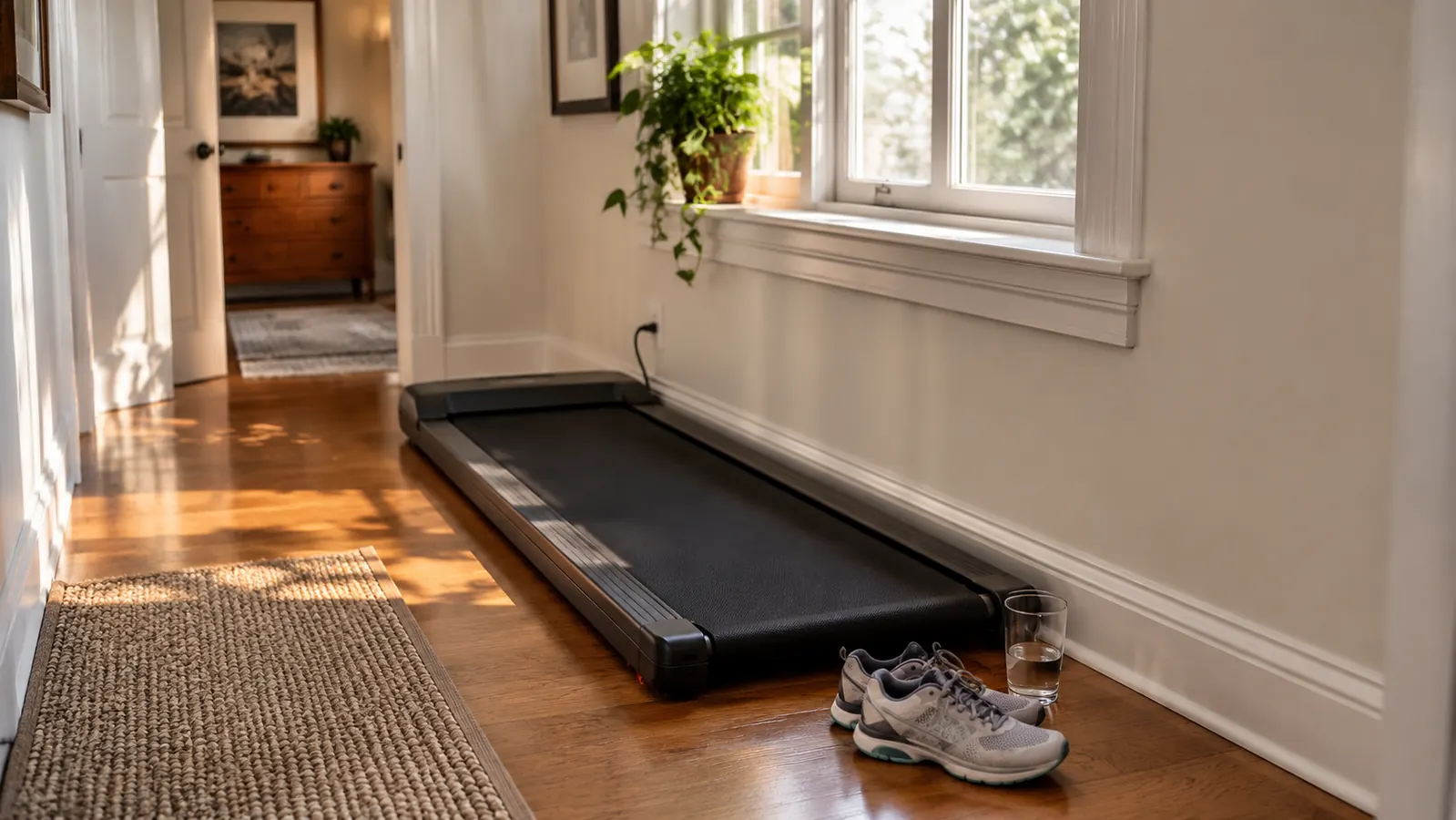
The UREVO is 45 inches long, 22 inches wide and just under 4 inches tall, and it weighs 43 pounds. That is small enough for a two-bedroom house and heavy enough that you will not want to carry it between rooms twice a day. Before anything gets ordered, put a tape measure on the floor where you think it will live. Then walk past that spot for a week and see whether it annoys you. I did this with painter's tape. The first spot I chose was the hallway between the kitchen and the front door, and the tape sat there three days before I admitted that a 22 inch wide machine in a 36 inch hallway means squeezing past it with a laundry basket twice a day. The end wall of the living room won. Dale's only comment was that it looked like a piece of furniture that had given up, which I chose to take as approval.
Mine sits at the end of the living room in front of the window, a few feet from a wall outlet. Not the bedroom, not pushed behind the couch, not down in the basement where the good intentions go. If I have to assemble my walking habit out of parts every morning, I will not do it. Visible and plugged in beats stored and safe, every time.
One number worth checking honestly is the 265 pound weight limit, against your own body and against anyone else in the house who might step on it. A machine that flexes under you is a machine you stop trusting, and a machine you stop trusting is a coat rack.
Step 3: Start at a speed that feels too slow, and stay there a week
The lowest speed on this pad is 0.6 miles per hour, which is slower than most people walk to the mailbox. My first week I set it at 1.2 and did ten minutes. It felt ridiculous. It also left me wanting to do it again the next morning, which is the entire job of a first week. Anyone can do ten minutes. That is the point. What I remember from that first morning is not the walk. It is standing there in my socks at 7:42 with the window still dark, thinking I had bought a very expensive place to stand. Ten minutes later I had done something. I kept a note on the calendar for those ten days and the notes were short: did it, did it, did it, skipped, did it.
Use the talk test. You should be able to say a full sentence out loud without gasping. If you cannot, drop the speed by half a mile per hour and try again tomorrow. For the first week I kept one hand near the wall, not because the pad needed steadying but because I did. That went away on its own.
After the first week I added two minutes, not two tenths of a mile per hour. Duration before speed. By week six I was at twenty minutes, and the walk had stopped being an event and started being part of the morning, the way brushing my teeth is part of the morning. I do not congratulate myself for brushing my teeth.
Twenty minutes on a wet Tuesday in February is worth more than the ninety minute walk I keep planning and not taking.
Step 4: Attach the walk to something you already look forward to
Habits stick when they are bolted onto something you already enjoy. I watch college basketball. From November to March there is almost always a game on in the late afternoon, and I do not let myself watch the second half unless I am on the pad. That is the whole system. It is not clever, and it has survived an entire winter, which is more than I can say for most of my systems. The first game I used it for was a conference game in early December that went to overtime, and I walked forty-one minutes without noticing, roughly twice what I had been managing all fall. I have never tried to repeat the overtime.
The display at the front of the UREVO shows your time and distance. I check it once at the start and once at the end. Watching it the whole way is like watching the clock at the dentist. If you want something to look at instead, the UREVO app connects over Bluetooth and offers simulated routes to walk, and I used them a handful of times before going back to basketball. If basketball is not your thing, pick whatever you already stay up late for. A show, a podcast, a long call with a friend. The rule is the same: the thing you enjoy is the reward, and the walking is how you earn it.
One rule I keep: the walk is not a punishment for what I ate. It is the half hour I get to watch a game and move at the same time. The moment it turns into a debt I am paying off, I start skipping it. I have watched that happen to me more than once.
Step 5: Add incline slowly, and set it before you start
The incline goes up to 11 percent and it is manual, which means you set it by hand before you step on. I stayed flat for two full weeks. Then I set it to 2 percent and left it there for a month. Then 4. I am at 6 most mornings now, and I can feel the difference in my calves on the days I forget. Slow is the whole instruction here.
Do not change the incline mid-walk. Nothing good happens when a person who is not paying attention adjusts an incline while their feet are moving. Pick your setting before you start. If your hips complain at a higher incline, finish the walk and go back to flat the next day rather than pushing through it out of stubbornness.
The top speed is 6.2 miles per hour and the motor is 2.25 horsepower, which is more machine than a walker needs. I stay between 2.8 and 3.0. It is a walking pad. The people I see running on these are younger and braver than I am, and I wish them well.
What Else Helps
Put on real shoes. Slippers are not shoes and the difference shows up in your shins by the second week. I keep a pair laced loose beside the pad so I can step into them without sitting down. Water within reach, a fan in July, and a rule that if something hurts in a sharp way rather than a tired way, I stop and I mention it at my next appointment. Talk to your doctor before you change your exercise, especially if you take medication for blood pressure or anything else that makes you dizzy.
The pad did not replace the dog. Mabel still gets her forty minutes outside whatever the machine does, rain or not, because she is seven and she has opinions. What the pad replaced was the nothing I used to do on the days the weather won. That is the honest trade. It is not a bigger life, it is a less interrupted one.
Keep some kind of record, and keep it dull. I put a small X on the kitchen calendar for every day I walk, and at the end of the month I count them. I am not going to tell you what to expect on the scale. My own weight came off slowly over a couple of years, walking was one part of it, and the measuring cups and the changed grocery list were the others. Results vary, and anyone who tells you otherwise is selling something.
The point was never the machine. It was the Tuesday in February.
If a walking pad is what gets you out of the chair on the days the weather wins, the UREVO Smart is a sensible one to look at. Manual incline to 11%, 6.2 mph top speed, Bluetooth to the UREVO app, 43 pounds, and a footprint you have already measured against your hallway.
Amazon Check Today's Price on Amazon →